Content warning: this comic includes depictions of off-panel self-harm, as well as nuclear explosions. Nothing super graphic, but I figured I should let people know.

Content warning: this comic includes depictions of off-panel self-harm, as well as nuclear explosions. Nothing super graphic, but I figured I should let people know.

This post is part of my ongoing project to migrate my old Art Is My Middle Name newsletter archives to my own website. Learn more about all that.
Originally published March 11, 2020
Hey, There,
So, last week I was briefly in a Twitter beef with Jimmy Carter’s grandson over whether it was sexist to claim that Yoko Ono broke up the Beatles.* That was resolved amicably, but it did get me thinking that maybe it’d be a good time for me to talk a little about performance art; for whatever reason, our society has decided that performance art is a perpetual punchline, and this is part (but only part, and it’s probably a distant second to raw sexism, and you can’t really discount unexamined racism) of why people are so endemically shitty about Yoko Ono, who made her name as a performance artist.
*Yes, it is. Check out the Recs section for more.
All right, then. Performance art. It’s a broad category, right? It’s an artist doing something and saying it’s art. Usually there’s some contextual element—the place where it happens is part of why it’s art, or the time it happens is part of why it’s art, or something about the artist’s identity is art of why it’s art, and so on. The key thing is that a person (or people) do something.
Continue reading Stop Picking on Performance ArtThis post is part of my ongoing project to migrate my old Art Is My Middle Name newsletter archives to my own website. Learn more about all that.
Originally published March 2, 2020
Hey, there,
So, again, I want to be really upfront that what I’m about to lay out here is in no way a responsible or serious way to approach art history. It’s a combination of a pattern that recurs a lot of times and a fairly outmoded means of framing some past art movements. If you tried to base any academic work on this, you’d deservedly get shit thrown at you.
But if you used it as grounds for shooting the shit with your friends, you’d probably have fun. So take it on that level.
OK. That’s a lot of preamble for a pretty simple thing: in my head, I have this kinda functional/kinda shitty model for the way a lot of cultural movements shake out. This started out thinking about art (and another disclosure here: I can’t tell for sure anymore how much of this is original thought on my part and how much is just kind of old art history zeitgeist that I’ve internalized), but it winds up making just as much sense in other cultural areas (brace yourself for a lot of music talk later). The basic idea is as follows:
Continue reading My Crackpot Theory of the 3 Phases of Cultural MovementsThis post is part of my ongoing project to migrate my old Art Is My Middle Name newsletter archives to my own website. Learn more about all that.
Originally published Feb. 18, 2020
Hey, there,
We had so damned much fun last week talking about industrial design that you know what, we’re gonna do it again! But this time, instead of boring stuff like schools, we’re gonna talk about something rad: the design history of the electric guitar (cue Van Halen’s “Hot for Teacher”).
For real, though, the evolution of the electric guitar is a pretty fascinating case study in the steady drift of 20th century design; as I was trying to argue last time, in the industrial and post-industrial age, mass-production design is sneakily the most common way art manifests in our lives. And I’ll actually be sneaking a pretty stark line-in-the-sand cultural history idea into the middle of this. Let’s dig in.
Bizarrely, the origins of the electric guitar lay in a couple of early 20th century musical crazes, neither of which seem particularly rocking from a distance. On one hand, there was a widespread, hard-to-imagine-now desire for Hawaiian music featuring guitars in nonstandard tunings, played with pipes or bars across the strings to produce awesome slide transitions between chords. Ideally, this setup calls for a small stringed instrument laying on the lap of the player. Traditional guitars were ungainly for this, with their large hollow wooden bodies, which were needed to amplify the sound of the vibrating strings.
That is until designers at what would become the Rickenbacker corporation designed a very Bauhaus-y “frying pan” electric guitar, which had electromagnetic pickups mounted *over* the strings to convert the vibration into an electric signal that then-cutting-edge radio-speaker technology could convert back into sound:

Minimal, geometric, come one. This isn’t from the Bauhaus, but it’s very much growing out of the same soil.
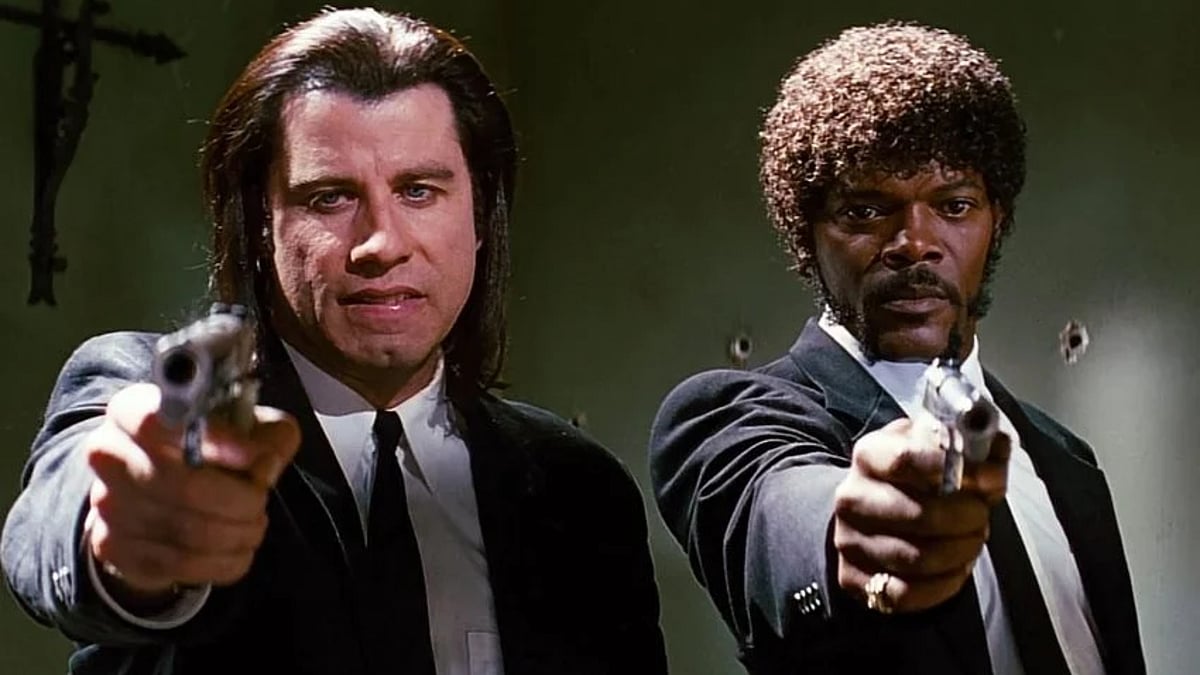
Continue reading Midcentury Modern, ShreddedI was hesitant to write about Pulp Fiction. For one thing, what else is left to say? And any sort of even half-serious engagement with the movie necessarily means wading into a couple of other bodies of discourse that are about as appealing as lighting myself on fire.
But if part of the brief of this project is to talk about movies from a given year that have some salience into my life, well, I can’t not talk about Pulp Fiction. But I’m going to take it for granted that you know the movie and, for the most part, look at it as an artifact in the wider culture. The omnipresence and massive cultural shadow of Pulp Fiction is both the interesting thing to talk about and the reason it’s more or less mandatory to talk about it. Because here’s another one of those you-had-to-be-there cultural/historical-moment things: this fucking thing smashed through the culture like a cannonball in 1994. It was massive and omnipresent! I’m pretty sure this is the last movie I remember hearing ads for on the radio!

RC and I have been talking a lot about how some rare works of art surprise you (maybe through formal properties, maybe through subject matter, maybe other dimension that you never even considered) and lodge in your brain for a while.* That’s what Pulp Fiction, which was certainly unique formally and at least unique in intensity on the subject matter side, was like in ’94, except instead of at the personal level, it was at a good-percentage-of-the-moviegoing-public level. You can argue that Tarantino doesn’t do original things, that all of his work is pastiche, and that’s pretty true. But for the public at large—certainly for me—in 1994, Pulp Fiction represented pastiche in a form most of us hadn’t encountered anything remotely like before, and I think something like that turns into the affirmative argument you can make for most of his career over the long haul.
*For what it’s worth, I think this factor of surprise is a big part of why I’m so bonkers about Andor; it was and remains a massively pleasant surprise that something so tight, relevant, and well-executed could exist; It’s almost inconceivable that it could come in the form of a Star Wars tv show, a medium whose usual payoff is “hey, remember that guy who was onscreen in Empire Strikes Back for 90 seconds? Well, here he is again.”
Continue reading A LIFE IN FILM #21 – PULP FICTIONThis post is part of my ongoing project to migrate my old Art Is My Middle Name newsletter archives to my own website. Learn more about all that.
Originally published Feb. 12, 2020
Hey, there,
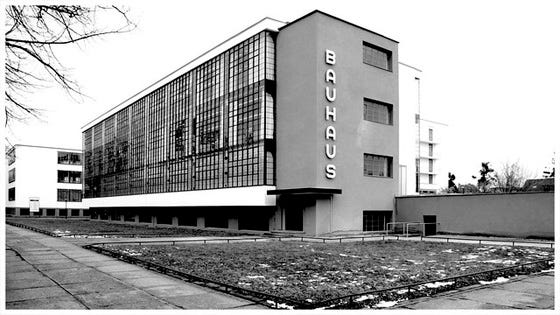
So it’s no secret that these are troubled times. I’ve been thinking a lot about a long-term art situation that maybe counts as an inspiring story where the good guys win in the long run, or at least their ideas do. If you’re willing to have kind of a fluid definition of “good guys,” I guess. Anyway: let’s talk about the life and death and long, triumphant afterlife of the Bauhaus.
What’s the Bauhaus, you ask? Why, the Bauhaus is many things! It’s the seminal Goth band, for one thing. Within the city of Minneapolis, it’s an apartment building whose appearance is kind of a visual pun AND it’s a brewery that makes so-so beer but has a really cool taproom that’s often full of dogs. But of course, these are all derivative names, shadows of the real thing.

The real Bauhaus that inspired all of these namesakes was a revolutionary art and design school in Germany in the 1920s and 30s. The Bauhaus sprang up immediately after World War 1 and lived and died with the liberal Weimar Republic; it was shut down by the Nazis immediately when they came to power for being decadent.
Continue reading Bauhaus / in Der Mitte of our StrasseThis post is part of my ongoing project to migrate my old Art Is My Middle Name newsletter archives to my own website. Learn more about all that.
Originally published Feb. 4, 2020; and that bit in the subhed where I said I was sick when I wrote this? Looking back, I’ve always wondered if that was actually covid. It’s early for the timeline, but that felt like later, confirmed bouts of covid that I had, and I *had* just traveled internationally. Who knows? Anyway, this piece is kind of a pre-covid time capsule. The class being described even got truncated by the pandemic in mid-March of 2020.
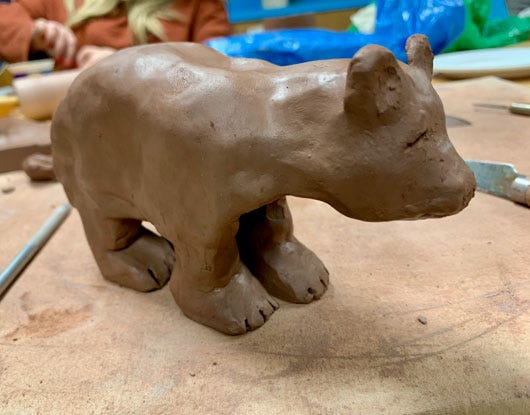
Way back when I was laying out the parameters of what this newsletter would be, deep in the last decade, I said that sometimes it’d cover making art, too; I guess this is one of those times.

Hey, there,
The decision to take a Community Ed pottery class wasn’t a hard one. I’d taken one pottery class previously, at the very end of undergrad,* and absolutely loved it. I remembered the excitement of, for the first time in 4 years of higher education, learning to do something with my hands. I remembered the satisfaction of seeing and feeling a form come together. I remembered the intense physical sensation of working with something on the wheel. The way glazes seemed like a fascinating, bottomless pool you could dive into and just get lost in. The feeling of my head going from total confusion to calm understanding under calm, patient tutelage.
*My undergrad class selection was done kind of badly; I came in as a physics major and spent about the first half of college being a snotty STEM kid and taking math and science classes. Then I recognized that I was miserable, switched my major to English, and had to cram an entire major into 5 quarters. While I was feverishly finishing my English major, I rounded out my schedule with “fun” classes that I was taking pass/fail. The last two of those fun classes were an art history survey class and a studio pottery class, and as I sat through and loved these art classes, I started to wonder if I hadn’t made a huge mistake with my whole educational program. 20 years and a haphazard wander into grad school would eventually fix this error.
Continue reading Art Report From the Front Lines: Minneapolis Community Ed PotteryThis post is part of my ongoing project to migrate my old Art Is My Middle Name newsletter archives to my own website. Learn more about all that.
Originally published Jan. 28, 2020
Hey, there,
So last week I had this uncharacteristic burst of positivity and was all set to write a buoyant, inclusive newsletter issue about how there’s no wrong way to visit a museum, that any thing you do that gets you inside the door interacting with exhibits is a good thing, even if it’s just a quest to go in and find the 6 ugliest paintings or because you like the view out of one of the windows.*
*FWIW, I do believe this pretty fervently.
And then, as I walked through the skyway, a crushing wave of reality hit me: of course, even with the most open-minded of visions, there are some wrong ways to visit a museum. I know this because I worked at museums for a decade and a half, and witnessed or heard about all kinds of ways that people—usually, but not always, horny teens—managed to find extremely wrong ways to visit museums. And then I asked around to other museum-y people I know for horror stories, and got a bunch more. Crucially, I should add that other people’s horror stories were emphatically not limited to teens; people of all ages can find bad ways to visit museums.
For me, the canonical example of this comes from the days when I worked at a large, encyclopedic art museum (I have this vague sense that I shouldn’t name the names of specific institutions in writing here, but rest assured that for the price of one beer I will happily do so in person), took a break to stroll through the galleries on a quiet day, and came across a couple of teen boys fondling a nude statue. More specifically, I guess, one was fondling the statue while the other looked on, very impressed. I told them to knock it off and they bolted.
Continue reading Museumgoers Gone WildThis post is part of my ongoing project to migrate my old Art Is My Middle Name newsletter archives to my own website. Learn more about all that.
Originally published Jan. 23, 2020
Hey, there,
I guess it’s time to talk about my least favorite painter. The art world is full of talented jerks, and if you throw a rock at the canon, you’re gonna hit someone who’s easy to hate. I’m not here to talk you out of whoever your bete noire happens to be, but I do want to spout off for a while about the guy I hate the most: Jacques-Louis David, the biggest kiss-ass in all of art history.
Honestly, the “biggest kiss-ass” thing is underselling the case for hating David. That was my gateway into hating David, but it turns out there’s a bunch more.
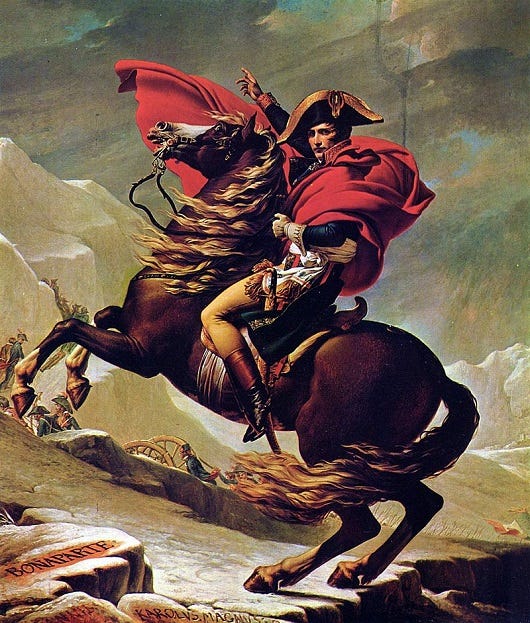
First, let’s establish who we’re talking about here. JLD* was a French painter who spanned the 18th and 19th centuries. His most prominent period overlapped with the French Revolution and the Napoleonic Wars. He was a tremendously gifted technical painter, as you can see here:

*Using “JLD” occasionally here just because typing his whole name out over and over is a drag. But the abbreviation feels weird, because I usually associate it with Julia Louis-Dreyfus, who has this mirror-image thing going by being as absolutely cool as David is sucky. Nature always balances out, I guess. Oh, while we’re all parenthetical, maybe this is a good place to point out that, being French, his last name is pronounced “Dah-veed.”
Continue reading You Know Who Sucks? Jacques-Louis DavidThis post is part of my ongoing project to migrate my old Art Is My Middle Name newsletter archives to my own website. Learn more about all that.
This one in particular was an urgent outburst in 2020 but you know what? I’ll stand by it in 2026, and think it’s all the more urgent. Just, uh, don’t use Substack now.
Originally published Jan. 16, 2020
Hey, there,
This began as a twitter rant the other day, and it kind of took off, much to my gratification. But Twitter is ephemeral, and I want to spread this message as far as I can. In fact, to that end, after you read this, please forward it to anyone who might be receptive.
OK, then.
*clears throat*
I have an earnest request for you (yes, you).
Start a blog in 2020! And start reading other peoples’ blogs!
RC and I were talking the other night night about how much it sucks that our society just drifted away from blogs after the big social media sites sprung up. I understand the historical reasons for this, but here’s the thing: NONE OF THOSE REASONS ARE DETERMINISTIC OR IRREVERSIBLE.
There used to be this wild, varied, untamed wonderland of personal expression through blogs and it was a thing of exquisitely messy human beauty.
Now, we all complain (rightly!) about the slow death of media outlets, especially those that have any spark of humanity in them. And we howl (rightly!) about how the big social media orgs, especially FB, are trying to turn the web back into a monetized AOLesque walled garden.
And those things are true, and they suck!
BUT A HUGE SUITE OF BLOGGING* TOOLS IS STILL JUST OUT THERE WAITING FOR ALL OF US TO PICK THEM UP, USE THEM, AND GIVE OURSELVES OUR VOICES BACK.
*and newslettering, which winds up being functionally damn near the same thing.
Writing for paying outlets is great if you’re interested in pursuing that, but there are always fewer of them, and you have to tailor your pitches to their tastes and the news cycle and what have you. And that’s fine, but THERE’S SO MUCH YOU HAVE TO SAY THAT DOESN’T FIT INTO THOSE BOXES.
And it’s intimidating to pitch stuff, and it sucks to get rejections. SO WRITE ABOUT WHAT INTERESTS YOU ON YOUR OWN BLOG WHERE NO ONE’S GONNA SAY NO TO YOU. YOU HAVE A VOICE AND IT’S AS IMPORTANT AS THE LATEST GODDAMNED BACHELOR RECAP ON A CORPORATE SITE.
Let your freak flag fly! Write about the weird shit that interests you! Not sure about your grammar or spelling? WHO GIVES A DAMN ABOUT YOUR GRAMMAR OR SPELLING? You still have things to say.
And then let the rest of us know about it! And on the flipside: we all can and should make an effort to be reading each other. Committing to this for 2020: I’m going to forcefully push to add idiosyncratic personal blogs back into my media diet.
I just got done reading* a book about kids in a fucking police state using darkrooms and silver nitrate to photo-reproduce newsletters to give themselves a voice; we’re all sitting here with the best communication system IN HUMAN HISTORY sitting in front of us unused.
*and won’t stop talking about, apparently
Google Reader died? WHO CARES? Every goddamned browser has a bookmark function. Or it’s not hard to type a URL.
If you don’t want to mess with blog software: start a newslettter! Then nobody has to remember to check your site; they just have to check their email. It took me less than 20 minutes to set up Art Is My Middle Name. It could not be easier.
So yeah. Start a blog, start a newsletter, and let everyone know about it so we can signal-boost it. And if you can boost your friends’ signals, DO IT.
OK, that’s it. Sorry about the shoutiness, but I feel strongly about this. Please at least give starting a blog, about whatever you feel like talking about, a serious think, and forward this to anyone who might be open to the same.
Newsletter’ll be back, maybe in a couple of weeks, in a more restrained form.
I recommend that you start a blog or a newsletter, and then let me know about it.
OK, so here at the bottom, sorry for the ragged copy editing; my deal with myself was to keep this fast and loose, which is gonna mean typos. On the other hand, that also means it’ll actually come out, instead of being obsessed over.
If you have any thoughts/reactions/what have you about this, I’d love to hear about it, either by email or on Twitter. And if you know anybody who might dig this, please forward it on to them, or send ‘em the signup link! And thanks!
This post is part of my ongoing project to migrate my old Art Is My Middle Name newsletter archives to my own website. Learn more about all that.
Originally published Jan. 14, 2020
Hey, there,
The plan was for this issue to be about what it actually means to have refined taste, which is a bee that’s been in my bonnet for a while. But then I got sucked into Burning Down the Haus, Tim Mohr’s book about punks in East Germany in the 70s and 80s, and that thing took over my whole brain. Refined taste is gonna have to wait.
Haus is fascinating, relevant, and moving from like 30 different angles (to me, at least, although a book about politically-active bands and punks in East Germany does sound like something developed in the lab to appeal as tightly to as many of my interests as possible). But the thing I want to focus on right here is a fundamental thing undergirding the book and the world its describing: the way that punk culture created a space through which East German kids could assert their own identities in a system that was geared to suppress identity (and for what it’s worth, I’d say the same thing is true about punks on the other side of the Iron Curtain, the difference being lower stakes and some details in how the overarching system tries to assign you an identity that’s convenient for its driving ideology).
Continue reading This Newsletter (/website) Has Been Hijacked by East German PunksThis post is part of my ongoing project to migrate my old Art Is My Middle Name newsletter archives to my own website. Learn more about all that.
originally published Dec. 29, 2019
Hey, there,
So I want to start out my talking about art by talking about a book (which is largely about art): Kurt Vonnegut’s Bluebeard. It’s not quite top-shelf Vonnegut, but it’s pretty good and certainly doesn’t deserve its obscurity. And as far as my life goes, Bluebeard was a big turning point in letting the idea of capital-a Art establish a beachhead in my brain.
Bluebeard is ostensibly the autobiography of Rabo Karabekian, a fictional Armenian-American Abstract Expressionist painter who became a national joke when the “futuristic” materials he used to create his paintings causes them all to fall apart. There’s a lot going on in Bluebeard, with time spent on the Armenian genocide and some admirable-in-intent-but-kind-of-falling-short-in-action feminist points being made, but the stuff that always stuck with me the most was “Karabekian” just addressing the reader and talking about painting and paintings (and since Vonnegut painted on the side, I don’t think it’s too outré to just read these sections as Vonnegut telling you what he thinks about painting).
Continue reading Bluebeard!A Life in Film is a project where I’m writing about a movie from every year I’ve been alive.
TRACK 1: BUDDHISM, SORT OF
They say that as you get older, you think about religion more. And maybe that’s true, or at least sort of true. I’m definitely older (why, I’m two years older than the last time I posted to this project), and I know that as time goes on, my thoughts get more and more existential. Not religious, really, because I have a hard time with supernatural beliefs. But definitely with an eye on to the bigger picture of existence and where I (/we) fit in and what’s going to happen when I’m not here anymore (mostly, I want to make sure my musical gear goes to somewhere it’ll get plenty of use).
I was raised Catholic, more or less, but it didn’t take; part of that was that my parents’ hearts weren’t really in it (which is fine). I was pretty much done with it, and Christianity, by the time I was driving. But I had a weird childhood, and in a very real sense I was raised in two households. And that second household was heavily influenced by a professor of comparative religion with a particular interest in India who had an active if idiosyncratic personal religious practice that sort of mixed Buddhist thought and practice with American Midwestern Lutheran culture.
I guess what I’m saying is that, while I can’t at all claim to have raised as a Buddhist (or, to be clear, to have any real sense of what a personal Buddhist practice is like outside of some very unusual conditions), I was at least out on the right end of the bell curve in terms of exposure to Buddhist concepts among teens in rural Nebraska in 1993. Cycles of rebirth and improvement within them, sure, yeah, weren’t we talking about that at dinner the other night?

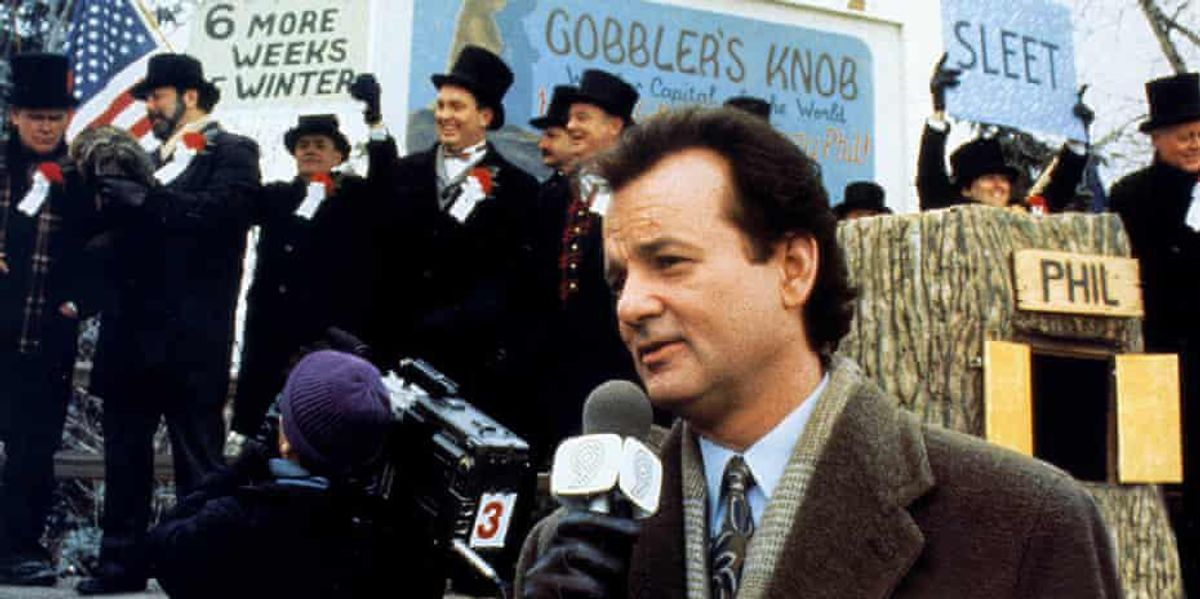
So, Groundhog Day landed pretty well in that second household of mine. Bill Murray’s asshole weatherman relives a day over and over and over, passing through waves of hedonism and nihilism until he improves himself and learns to accept his feelings in the moment, and is released from the cycle.* The resonance is right there out in the open (the lore about the script is a little muddled, with stories both crediting Harold Ramis for strengthening the Buddhist parallels, and faulting him for downplaying them, to the detriment of his relationship with Murray; in the end, it matters less how they got there than that they’re there).
Continue reading A LIFE IN FILM #20 – GROUNDHOG DAY