A Life in Film is a project where I’m writing about a movie from every year I’ve been alive.
1993: Buddhism and Also the Murray Problem
GROUNDHOG DAY (dir. Harold Ramis)
TRACK 1: BUDDHISM, SORT OF
They say that as you get older, you think about religion more. And maybe that’s true, or at least sort of true. I’m definitely older (why, I’m two years older than the last time I posted to this project), and I know that as time goes on, my thoughts get more and more existential. Not religious, really, because I have a hard time with supernatural beliefs. But definitely with an eye on to the bigger picture of existence and where I (/we) fit in and what’s going to happen when I’m not here anymore (mostly, I want to make sure my musical gear goes to somewhere it’ll get plenty of use).
I was raised Catholic, more or less, but it didn’t take; part of that was that my parents’ hearts weren’t really in it (which is fine). I was pretty much done with it, and Christianity, by the time I was driving. But I had a weird childhood, and in a very real sense I was raised in two households. And that second household was heavily influenced by a professor of comparative religion with a particular interest in India who had an active if idiosyncratic personal religious practice that sort of mixed Buddhist thought and practice with American Midwestern Lutheran culture.
I guess what I’m saying is that, while I can’t at all claim to have raised as a Buddhist (or, to be clear, to have any real sense of what a personal Buddhist practice is like outside of some very unusual conditions), I was at least out on the right end of the bell curve in terms of exposure to Buddhist concepts among teens in rural Nebraska in 1993. Cycles of rebirth and improvement within them, sure, yeah, weren’t we talking about that at dinner the other night?
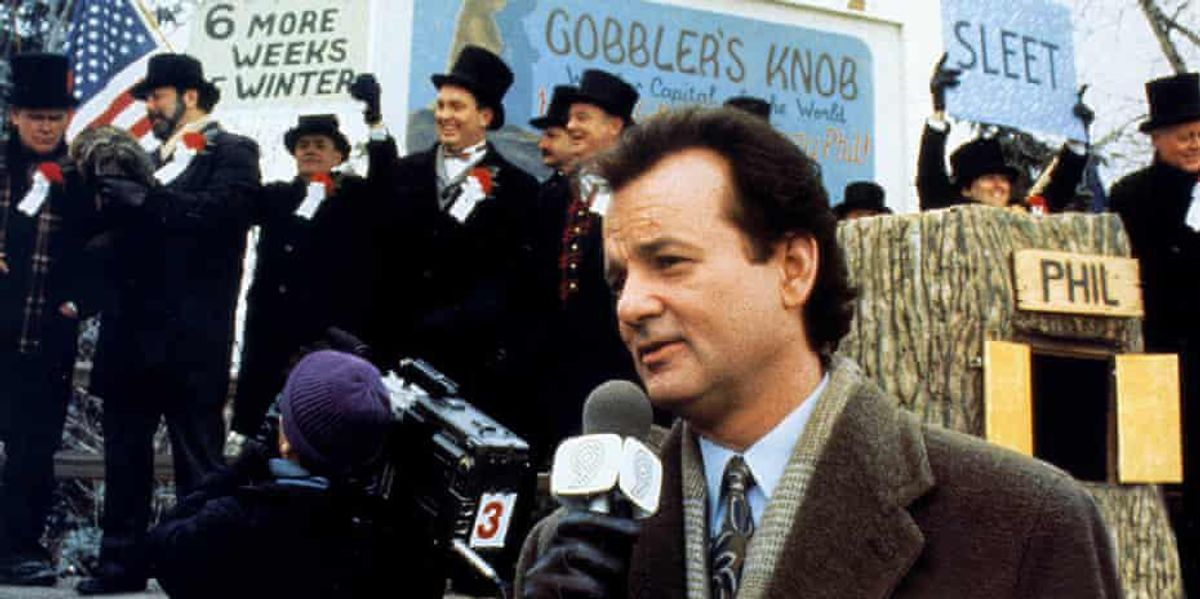
So, Groundhog Day landed pretty well in that second household of mine. Bill Murray’s asshole weatherman relives a day over and over and over, passing through waves of hedonism and nihilism until he improves himself and learns to accept his feelings in the moment, and is released from the cycle.* The resonance is right there out in the open (the lore about the script is a little muddled, with stories both crediting Harold Ramis for strengthening the Buddhist parallels, and faulting him for downplaying them, to the detriment of his relationship with Murray; in the end, it matters less how they got there than that they’re there).
*This, if course, is the interpretation that was settled on in my second childhood household; the more prosaic (although still not super prosaic, since it does involve escaping from a time loop) is that Phil is released from the cycle by the love of Rita. I can’t categorically say that you’re wrong if this is what you take from the movie. But I know it hits me as the way less interesting read.
I’ve been rewatching Deadwood lately (great Groundhog Day connection: Stephen Tobolowsky is fun in Groundhog as Ned Reyerson, the most obnoxious man on earth; but Tobolowsky’s appearances in Deadwood as the gleefully corrupt Commissioner Hugo Jarry represent one of the funniest performances I’ve ever seen), and I’ve gone through kind of a convoluted thought reaction that I’ll try to lay out here: 1. show auteur David Milch really does have some interesting things to say about how society coheres and functions, and what has to happen within that process; but 2. you can’t treat a movie as like a puzzle that you can unlock and get immutable secret truths, at bottom it’s always just a person (or team of people) saying what they think, but then also 3. you know what? So is every other piece of art or philosophy or basic communication between people, in the end it’s all just people saying what they think, to be evaluated and accepted or discarded as seems appropriate.
Which is a roundabout way of acknowledging that I don’t think it makes any sense to hold up Groundhog Day, a studio comedy made in Hollywood in the 1990s, as a literal Buddhist text. But if you look at it as a movie where a bunch of creative people took some religious thought they’d been exposed to and worked that into the threads of a comedy, well, that ends up being a pretty interesting example of people saying what they think. And Phil exemplifying through his many relived days that empty hedonism and nihilism and crass opportunism lead nowhere, while helping people and learning a musical instrument and—above all—simply living in a moment and accepting his happiness there leads to his freedom, well, that does seem to me like a pile of thoughts with some useful things to consider, whatever its orthodoxy.
TRACK 2: THE MURRAY PROBLEM
The original spec-script version of Groundhog Day was written by Danny Rubin, with rewrites by Harold Ramis, who directed the movie. Both of them deserve massive amounts of credit for it, as do Andie McDowell (who I don’t normally like much, but who is delightful here) and Chris Elliot and the rest of the cast and crew. But this is very much Bill Murray’s movie, maybe *the* Bill Murray movie (it’s kind of fascinating how between this and Scrooged, “Bill Murray plays an asshole who learns to be a better person” was very close to establishing itself as a distinct genre). He’s somehow still sort of charming when Phil’s in asshole mode; he sells every step of Phil’s journey of improvement perfectly.
I personally can’t imagine the movie working with anyone else as Phil (although Michael Keaton, who was apparently offered the role and turned it down, might have been interesting). It probably works because Murray’s default persona—the guy who cracks wise because he doesn’t really want to be there and thinks he’s too cool for the situation—is itself a thing you’d work through if you were on an extended journey of enlightenment. Murray’s perfect for the role, and the blend of soulful comedy he brings to it ended up being the springboard to all of his lauded elder-statesman work in the back half of his career. Almost no one in Hollywood can hand out performances like Murray’s.
So Murray’s uniquely magnetic onscreen and at least for a while also seemed to exist as sort of a trickster-figure folk hero in the wider culture. He also seems to be a very difficult person to get along with on-set and in real life. That on its own isn’t a huge deal, but Murray’s one of those people about whom there’s always a more troubling set of discourse if you pay attention. His ex-wife Jennifer Butler accused him of domestic violence in their divorce filing in 2008; a movie production he was part of in 2022 was suspended after Murray was accused of sexually harassing a female crew member (he paid a reported $100,000 in a private settlement).

All of which: I don’t think Bill Murray is like a Polanski- or Allen-level monster. He’s just a guy who seems to suck in some pretty major ways. The calculus for what to do about that is different for every person (honestly, it’s not always easy even for the monsters; I had a solid “no Woody Allen” policy going for myself until Diane Keaton died and I realized that, for me at least, it felt kind of imperative to watch Annie Hall and appreciate again how great she was in it). I think for me, Murray lands in the gray zone where the decision to watch a movie he’s in is always going to have to overcome a little bit more of a speed bump than other movies, and watching it is usually going to be a balancing act for me between genuinely enjoying his very real talent while reminding myself to keep in mind that the dude sucks. This is uneasy territory, but it’s somewhere we all have to land in if we’re paying any attention to the world. It’s at least easier now that the trickster-folk-hero thing seems to have died out.
MISCELLANEOUS
-Tobolowsky is of course the king of the extended cast here, but one thing that surprised me when I was looking things up for this piece: Groundhog Day represents the first screen appearance for a baby Michael Shannon, who plays a young man in Punxatawny who’s getting married. I absolutely did not recognize him when I watched it last night.
-It says a lot about how great Groundhog Day is that a sort of conceptual remake, Palm Springs (2020), manages to be about 75% as good and, in doing so, still qualifies as one of the better comedies of the current decade.
-The only way Groundhog Day fails: good god does this movie suffer from Awful 90s Soundtrack Disease. “I Got You Babe” is the song you remember, because you hear it so much, and it’s not so bad. But everything else? Honestly, I understand why the mid 90s turned into a time when people responded to actually-good needle drops in movies.