A Life in Film is a project where I’m writing about a movie from every year I’ve been alive.
1994: Omipresence Means Radio Ads and Mall Bookstores
PULP FICTION (dir. Quentin Tarantino)
I was hesitant to write about Pulp Fiction. For one thing, what else is left to say? And any sort of even half-serious engagement with the movie necessarily means wading into a couple of other bodies of discourse that are about as appealing as lighting myself on fire.
But if part of the brief of this project is to talk about movies from a given year that have some salience into my life, well, I can’t not talk about Pulp Fiction. But I’m going to take it for granted that you know the movie and, for the most part, look at it as an artifact in the wider culture. The omnipresence and massive cultural shadow of Pulp Fiction is both the interesting thing to talk about and the reason it’s more or less mandatory to talk about it. Because here’s another one of those you-had-to-be-there cultural/historical-moment things: this fucking thing smashed through the culture like a cannonball in 1994. It was massive and omnipresent! I’m pretty sure this is the last movie I remember hearing ads for on the radio!
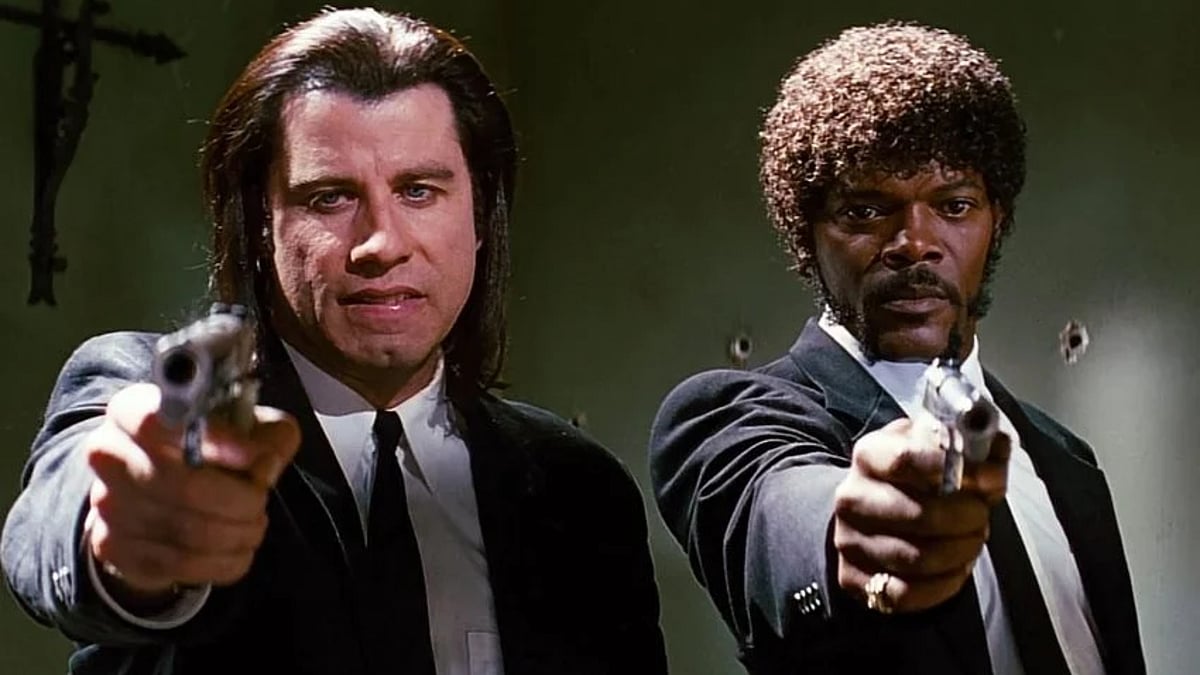
RC and I have been talking a lot about how some rare works of art surprise you (maybe through formal properties, maybe through subject matter, maybe other dimension that you never even considered) and lodge in your brain for a while.* That’s what Pulp Fiction, which was certainly unique formally and at least unique in intensity on the subject matter side, was like in ’94, except instead of at the personal level, it was at a good-percentage-of-the-moviegoing-public level. You can argue that Tarantino doesn’t do original things, that all of his work is pastiche, and that’s pretty true. But for the public at large—certainly for me—in 1994, Pulp Fiction represented pastiche in a form most of us hadn’t encountered anything remotely like before, and I think something like that turns into the affirmative argument you can make for most of his career over the long haul.
*For what it’s worth, I think this factor of surprise is a big part of why I’m so bonkers about Andor; it was and remains a massively pleasant surprise that something so tight, relevant, and well-executed could exist; It’s almost inconceivable that it could come in the form of a Star Wars tv show, a medium whose usual payoff is “hey, remember that guy who was onscreen in Empire Strikes Back for 90 seconds? Well, here he is again.”
The immediate effect of Pulp Fiction’s cultural cannonballing was, well, everyone talking about when it was out, and the soundtrack achieving a state of total ubiquity (at least in the dorms of the University of Minnesota-Morris). Longer-term, it sort of set the agenda (or at least carved out a distinct lane) for a lot of indie or pseudoindie cinema for the rest of the 90s; the list of 90s movies that were in some way trying to bite on Pulp Fiction would represent a big percentage of non-blockbuster movies of the 90s.* One of the last great Simpsons episodes was a direct homage.
*This list would include Swingers, by the way, which helped launch the career of Jon Favreau, which means that Pulp Fiction is indirectly responsible for the phenomenon of Star Wars tv being a sea of “hey, remember that guy who was onscreen in Empire Strikes Back for 90 seconds? Well, here he is again.”
Alongside the giant pile of movies trying to glide in Pulp Fiction’s slipstream, it’s worth noting how much the movie’s cast went on to dominate the 90s. It took Travolta around a decade to piss away the goodwill he generated with his performance (and you have to remember, he was completely washed up before this). The modern/peak conceptions of Samuel L. Jackson, Christopher Walken, Bruce Willis, and Uma Thurman all stem from Pulp Fiction to one degree or another. Ving Rhames got a bunch of work. Tim Roth, Harvey Keitel, and Amanda Plummer all just sort of burnished their reputations. For the rest of the decade, the appearance of any of the main cast often served as a signifier that a movie was cool and interesting.
There was, of course, one notable casting whiff in Pulp Fiction: the character of Jimmie, played by one Q. Tarantino. Tarantino’s plodding, tone-deaf delivery drags the movie to a halt, and it’s always particularly cringeworthy to me that Tarantino self-inserted so that he could be the character who mouths a bunch of slurs; that feels self-revealing in a really not-great way.
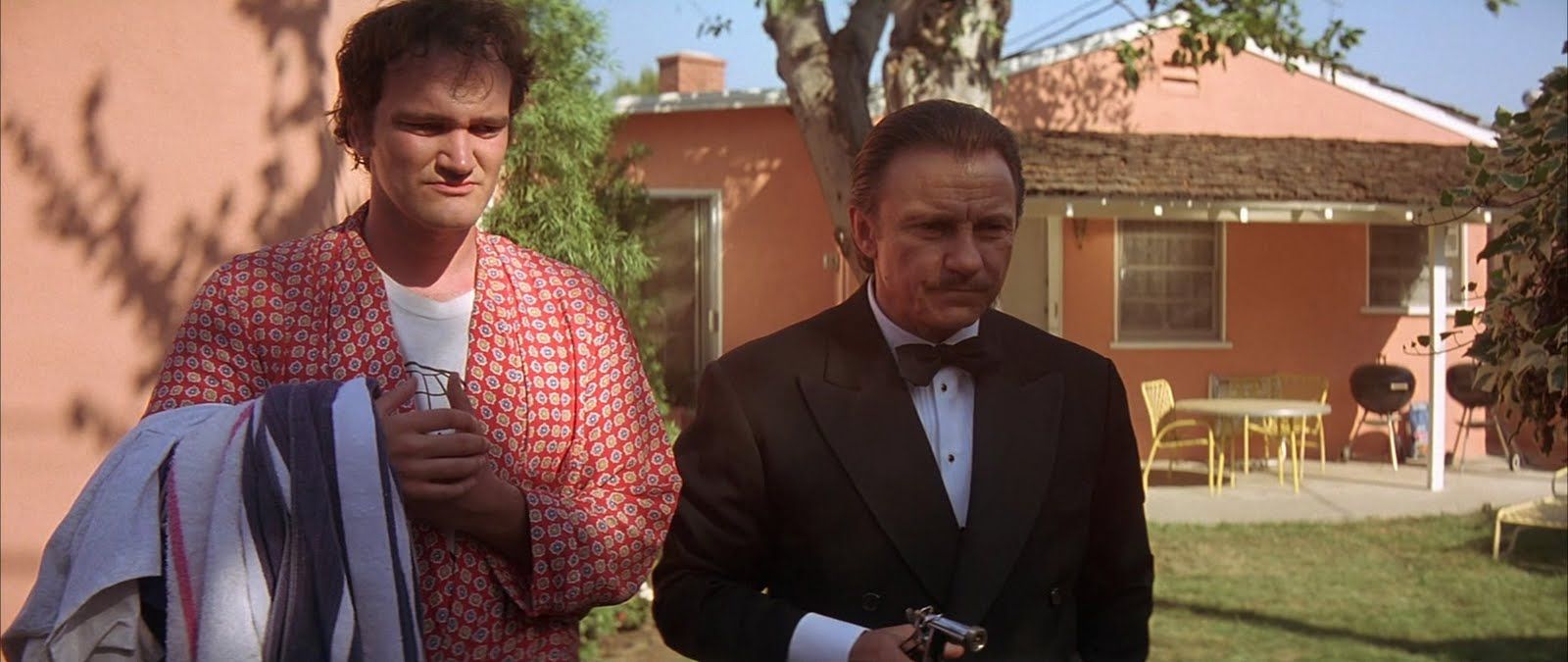
And that matters! Tarantino made—with some asterisks attached—a pretty great movie. It’s noteworthy that most of the on-screen black marks against it involve him appearing directly in it. That’s not the mark of a healthy ego, and, uh, we’ll be circling back to that. But, still: great movie. The screenplay—which, in a nod to how huge PF’s cultural impact was, I owned after buying a copy at a mall bookstore in St. Cloud, Minnesota– is tight, propulsive, and unconventional, if full of writerly tics.* It’s also kind of empty; I can personally vouch that English departments in the 90s desperately wanted to find a meaning in Pulp Fiction,** but the only real meaning there is “Quentin Tarantino knows how to make conceive very entertaining film sequences.” Which, to be fair, isn’t nothing.
*it’s not an accident that when you watch Crimson Tide, if you go in knowing that Tarantino did some script punchup, you can spot his sections immediately.
**Proof that the past is another country: a staple of the early internet was endless all-text discussion about what must be in that briefcase that’s so important and endless “here is textual proof that it’s Wallace’s soul” that, looking back, feels like an alpha version of modern internet conspiracy thinking.
To give Tarantino credit: for my money, he did actually manage to land a few more fundamental surprises through the course of his career; Inglourious Basterds didn’t have the same cultural omnipresence, but it did get me to a similar “wait, holy shit, you can *do* that?” place, and that’s something to be treasured. And any filmmaker who can get me there twice is someone I can’t write off completely.
But I can write him off at least partially. Whatever you think of Once Upon a Time in Hollywood, the figure of Current-era Tarantino hits me as a pathetic one. If the guy was capable of just being a little bit normal about himself, he could have gone on making movies forever, with the usual mix of duds and triumphs. And if the ratio of that mix changed over time, that’s life, and you still get some triumphs. But instead: the dude’s locked in a weird ego prison of his own design with his “there must only be ten Tarantino films” bullshit, seemingly unable to get rolling on a next film because it has to be a climactic last-work magnum opus instead of just the next movie. This seems to have left him stuck, unable to do anything but sit on the sidelines and say stupid shit about actors while, say, Martin Scorsese rolls along in his 80s making masterpieces. Current Tarantino is up there in the Hunter Thompson class of genuine talent drowning in the creator’s own bullshit; now he can’t even make a damn movie (with One Battle After Another, it feels to me like P. T. Anderson has now started making the movies you’d hope to see from Tarantino, and honestly I think OBAA might be better than anything Tarantino’s done).
But also: Pulp Fiction gets held up as kicking off—or at least accelerating—a wave of independent film. And even if a bunch of those movies weren’t essentially inferior cover versions, we also have to reckon with the fact that this movie and the industry sector it helped create were all closely associated with Harvey Weinstein, an absolutely monstrous piece of shit. I’m not going to go into Weinstein here beyond saying that I hope he dies in prison; but he stains the legacy of Pulp Fiction by his involvement in both the movie and the PF-dominated Hollywood of the turn of the century.
Where does that leave us? In an uncomfortable spot, I guess. I’ll always have some level of love for Pulp Fiction, even if I can see a lot of valid areas for direct criticism and a lot of problematic stuff associated with the wider picture. I’ll watch it again, but if I’ll cringe in spots. I’ll enjoy it. But it will never surprise me again like it did in ‘94, and if a 10th Tarantino movie ever does get made, I doubt it will, either.