A Life in Film is a project where I’m writing about a movie from every year I’ve been alive.
1996: Oh Geeze
FARGO (dir. Joel Coen, officially; but come on, Ethan was there)
OK, here we go. This is it, this is the big one (clutches chest like Fred Sanford). There’s some wiggle to this, but on most days if you asked me what my favorite movie was, my honest answer would be Fargo. It’s the movie I use to gauge the beginning of my mental adulthood; it’s a loving but pointed document of a place I love; but most of all, it’s a stupendous work of art on its own merits.
I didn’t always think so. I saw Fargo in its initial run, and massively didn’t get it. Profoundly didn’t get it. A couple of years later, I saw it again and GOT it, and all I can conclude is that somewhere in that space, my adult critical faculties finally came fully online. It’s handy to have a solid calibration on that.
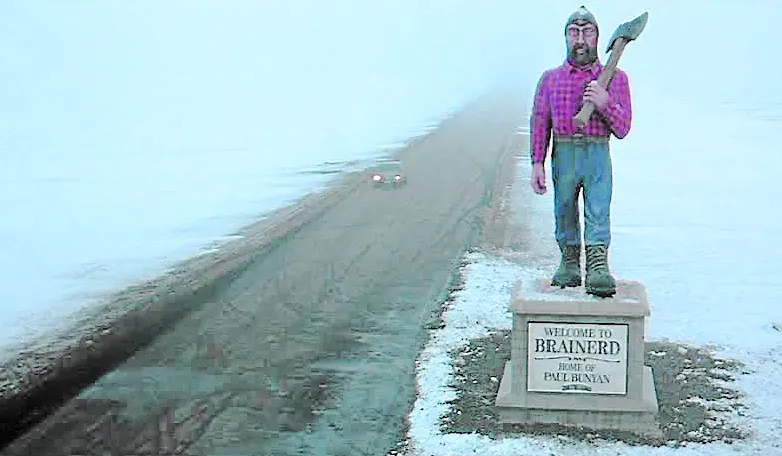
Actually, the story of how I first saw Fargo is a pretty good one. I was still in undergrad, and at the time I was dating a girl from Brainerd. I’d gone back to her parents’ place in Brainerd with her for the weekend, and she wanted us to hang out with her high school friends, so we all went to see this hot new movie that everyone was talking about that was—can you believe it—kind of about Brainerd. So we went to see it, and, well, everyone was flummoxed; nobody hated it, but nobody really knew what to make of it.* But: the film, famously, starts out with the statement “This is a true story. The events depicted in this film took place in Minnesota in 1987. At the request of the survivors, the names have been changed. Out of respect for the dead, the rest has been told exactly as it occurred.” Unfamiliar with the Coens’ sensibility (although I shouldn’t have been), I asked the group of befuddled Brainerdians if that was true, and they all muttered and nodded and said yeah, they were pretty sure they remembered it, back in the 80s, sure was weird when it happened.
For whatever reason, I think about this a lot.
*One joke that absolutely did land: there is no laughter more pure than a theater full of central Minnesotans reacting to Steve Buscemi burying a briefcase of money in a snowbank next to a highway and looking around for landmarks.
Looking back, I’m amazed at how much I missed on that first Fargo viewing. I mean, way beyond not getting the “this is a true story” joke. I remember a distinct feeling that the subdued lighting and 80s-shabby interior of the Lundegaards’ home meant that this was a low-rent, low-effort movie; now it’s clear to me that it’s very intentional, a masterpiece of mise-en-scene, very clearly communicating who these people are and when and where this is happening.
And Dumb, Young Me didn’t know a damn thing about cinematography, so I was completely unequipped to admire the absolute highlight reel of amazing, beautiful, and evocative shots Roger Deakins strings together throughout the length of the film

At the same time, I think I was just too young and literal-minded to really appreciate the script. On one level, Fargo is like The Big Lebowski (which, full credit to me: that one I got on first viewing) in being a ridiculous, outlandish story told in varying levels of deadpan (my first reflex is that Fargo does a better job of keeping a straight face, but I’m not sure that’s true; but maybe in Fargo’s case, the mortal stakes act as a stronger counterweight to the outlandishness). One of the things that makes Fargo a masterpiece is that just about everything in it is simultaneously a deadpan joke and also serious as hell. Marge is a little ridiculous (I love the way McDormand sells her excitement when she spots the criminals’ car) but she’s also something close to a creature of pure righteousness. The criminals are preposterous but they’re also piece-of-shit killers. Jerry Lundegaard is… man, Jerry Lundegaard is a lot.
It winds up being a pretty complicated semiotic program, definitely more than I could puzzle out at age 21. Talking about it now actually makes me think of another Minnesota creative force that had something similar going on: the music of Paul Westerberg and the Replacements. Westerberg’s a fantastically talented man who’s also, depending on how you look at it, either very troubled or a total butthole. And Westerberg’s psychological complexity is key to the power of his music. Part of him is a sensitive, observational person who has feelings and wants to write about them. But another part of him is a cynical nihilist who thinks feelings are dumb. So he writes sincere, aching songs, but with an ironic edge that undercuts the sincerity, but then delivers them in a way that, in turn, undercuts the undercut. The end result is that every Replacements is a multistage rocket with different layers of emotional truth in tension with each other. This isn’t exactly what the Coens are up to in Fargo, but it’s in the ballpark.
I dunno; maybe I’m projecting. But it feels to me like there’s a sameness between the work of the Coens and Westerberg, and (again possibly projecting) I think it does grow out of a sensibility that’s pretty widespread in Minnesota, or at least the Twin Cities. Maybe the famous Minnesotan discomfort with feelings leads some people to develop complicated multivalent systems of irony to deal with them. Maybe the endless winters lead to introspection and a bleak worldview. Maybe I’m entirely full of shit. But I don’t think so; I don’t think it’s an accident that I was drawn to live in a place that produced so many people who created complicated art. (to be clear: I’m not saying all Minnesotans are complicated and sensitive creative types; the fucking MyPillow guy is from up here. But the state sure does manage to produce a lot of them)
Fargo’s a movie that demands analysis. And that’s rewarding but I also think it can turn into a trap. It’s a mistake to treat a movie as a puzzle to be solved, a code that you can crack to get to a tidy reward. Fargo has stuff to say—it makes a moral case, put into Marge’s mouth at the end when she gives her “and all for a little bit of money” speech—but it’s not like a hermetically-sealed moral universe. There’s no absolute 1:1 moral schema I can come up with for it that makes sense from the point of view of Jean or Scotty Lundegaard. But there’s a lot there to chew on. I talked a few installments ago about how we all wanted Pulp Fiction to mean something, when it doesn’t mean anything more than “Quentin Tarantino knows how to entertain you.” Fargo is a case where some actual meaning and heft are wedded to an entertaining-you capacity that’s at least equal to Tarantino’s. Maybe that’s all the analysis it needs.
MISC
-When I was younger, I was also angry about the nonsensical Minnesota geography of Fargo (among many other things, Brainerd is nowhere near I-35, which you also could not take from Fargo to the Twin Cities, which we *also* see the criminals enter from the south). When I was older, I accepted that it was just movie geography, streamlined for the purposes of the story. These days, I think maybe they did it on purpose, knowing well how nuts it would drive some Minnesotans.
-But god, how about the performances in this thing? McDormand is perfect, maybe doing her best work. Buscemi comes across as doing a thing so effortlessly that you don’t register at first how hard he’s working and what a great job he’s doing. And Macy’s Jerry Lundegaard: jesus christ, what a performance.
-As for Noah Hawley’s Fargo tv show: it has some moments, but overall I think it serves to show just how great the Coens were at their best. Hawley takes the same elements and fits them together over and over and never manages to recapture the essential spirit of the thing. It’s not enough to combine deadpan Midwesterners and graphic violence; you have to understand the emotional resonance of what you’re doing. Hawley never seems to; the Coens always had total control over it.
Ope, gotta go. Prowler needs a jump.