Category Archives: Art History

Stop Picking on Performance Art

If nothing else, you really don’t want to piss off performance artists

This post is part of my ongoing project to migrate my old Art Is My Middle Name newsletter archives to my own website. Learn more about all that.


Originally published March 11, 2020

Hey, There,

So, last week I was briefly in a Twitter beef with Jimmy Carter’s grandson over whether it was sexist to claim that Yoko Ono broke up the Beatles.* That was resolved amicably, but it did get me thinking that maybe it’d be a good time for me to talk a little about performance art; for whatever reason, our society has decided that performance art is a perpetual punchline, and this is part (but only part, and it’s probably a distant second to raw sexism, and you can’t really discount unexamined racism) of why people are so endemically shitty about Yoko Ono, who made her name as a performance artist.

*Yes, it is. Check out the Recs section for more.

All right, then. Performance art. It’s a broad category, right? It’s an artist doing something and saying it’s art. Usually there’s some contextual element—the place where it happens is part of why it’s art, or the time it happens is part of why it’s art, or something about the artist’s identity is art of why it’s art, and so on. The key thing is that a person (or people) do something.

Continue reading Stop Picking on Performance Art

My Crackpot Theory of the 3 Phases of Cultural Movements

This is more “idle talking to people at a party” art history than “responsible, well-grounded, academic” art history

This post is part of my ongoing project to migrate my old Art Is My Middle Name newsletter archives to my own website. Learn more about all that.


Originally published March 2, 2020

Hey, there,

So, again, I want to be really upfront that what I’m about to lay out here is in no way a responsible or serious way to approach art history. It’s a combination of a pattern that recurs a lot of times and a fairly outmoded means of framing some past art movements. If you tried to base any academic work on this, you’d deservedly get shit thrown at you.

But if you used it as grounds for shooting the shit with your friends, you’d probably have fun. So take it on that level.

OK. That’s a lot of preamble for a pretty simple thing: in my head, I have this kinda functional/kinda shitty model for the way a lot of cultural movements shake out. This started out thinking about art (and another disclosure here: I can’t tell for sure anymore how much of this is original thought on my part and how much is just kind of old art history zeitgeist that I’ve internalized), but it winds up making just as much sense in other cultural areas (brace yourself for a lot of music talk later). The basic idea is as follows:

Continue reading My Crackpot Theory of the 3 Phases of Cultural Movements

Midcentury Modern, Shredded

The images in here can double as my Christmas list

This post is part of my ongoing project to migrate my old Art Is My Middle Name newsletter archives to my own website. Learn more about all that.


Originally published Feb. 18, 2020

Hey, there,

We had so damned much fun last week talking about industrial design that you know what, we’re gonna do it again! But this time, instead of boring stuff like schools, we’re gonna talk about something rad: the design history of the electric guitar (cue Van Halen’s “Hot for Teacher”).

For real, though, the evolution of the electric guitar is a pretty fascinating case study in the steady drift of 20th century design; as I was trying to argue last time, in the industrial and post-industrial age, mass-production design is sneakily the most common way art manifests in our lives. And I’ll actually be sneaking a pretty stark line-in-the-sand cultural history idea into the middle of this. Let’s dig in.

Bizarrely, the origins of the electric guitar lay in a couple of early 20th century musical crazes, neither of which seem particularly rocking from a distance. On one hand, there was a widespread, hard-to-imagine-now desire for Hawaiian music featuring guitars in nonstandard tunings, played with pipes or bars across the strings to produce awesome slide transitions between chords. Ideally, this setup calls for a small stringed instrument laying on the lap of the player. Traditional guitars were ungainly for this, with their large hollow wooden bodies, which were needed to amplify the sound of the vibrating strings.

That is until designers at what would become the Rickenbacker corporation designed a very Bauhaus-y “frying pan” electric guitar, which had electromagnetic pickups mounted *over* the strings to convert the vibration into an electric signal that then-cutting-edge radio-speaker technology could convert back into sound:

Minimal, geometric, come one. This isn’t from the Bauhaus, but it’s very much growing out of the same soil.

Continue reading Midcentury Modern, Shredded

A LIFE IN FILM #21 – PULP FICTION

1994: Omipresence Means Radio Ads and Mall Bookstores

PULP FICTION (dir. Quentin Tarantino)

I was hesitant to write about Pulp Fiction. For one thing, what else is left to say? And any sort of even half-serious engagement with the movie necessarily means wading into a couple of other bodies of discourse that are about as appealing as lighting myself on fire.

But if part of the brief of this project is to talk about movies from a given year that have some salience into my life, well, I can’t not talk about Pulp Fiction. But I’m going to take it for granted that you know the movie and, for the most part, look at it as an artifact in the wider culture. The omnipresence and massive cultural shadow of Pulp Fiction is both the interesting thing to talk about and the reason it’s more or less mandatory to talk about it. Because here’s another one of those you-had-to-be-there cultural/historical-moment things: this fucking thing smashed through the culture like a cannonball in 1994. It was massive and omnipresent! I’m pretty sure this is the last movie I remember hearing ads for on the radio!

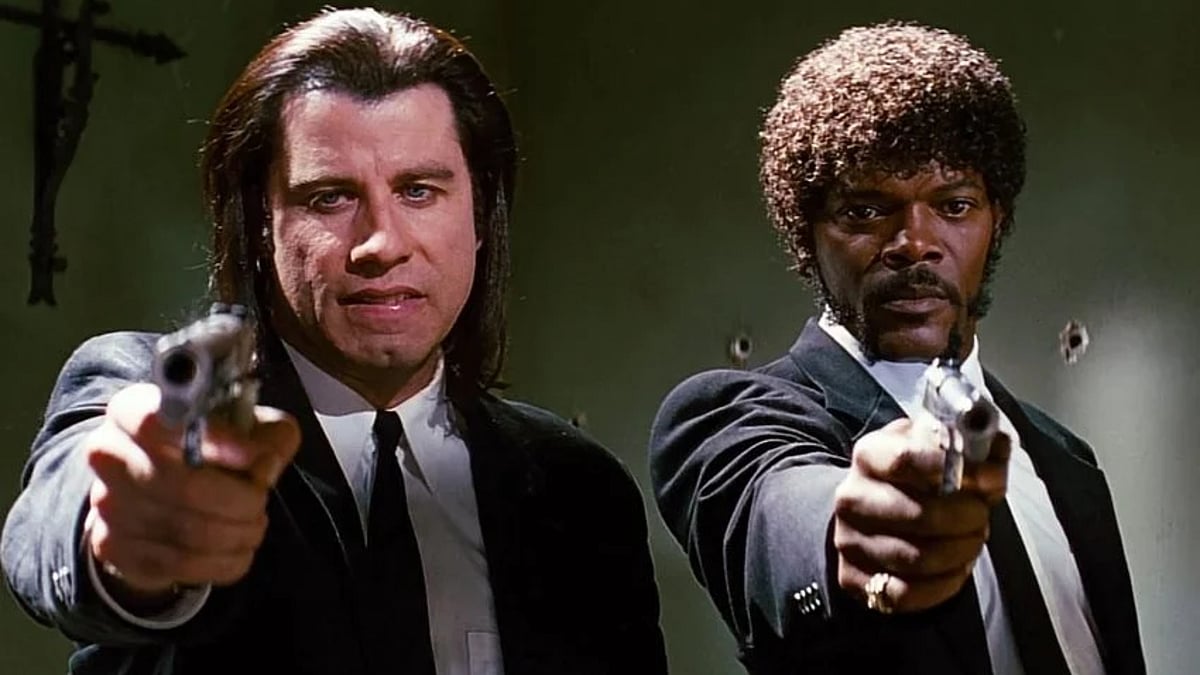
But I mean god does almost every frame of this movie look great

RC and I have been talking a lot about how some rare works of art surprise you (maybe through formal properties, maybe through subject matter, maybe other dimension that you never even considered) and lodge in your brain for a while.* That’s what Pulp Fiction, which was certainly unique formally and at least unique in intensity on the subject matter side, was like in ’94, except instead of at the personal level, it was at a good-percentage-of-the-moviegoing-public level. You can argue that Tarantino doesn’t do original things, that all of his work is pastiche, and that’s pretty true. But for the public at large—certainly for me—in 1994, Pulp Fiction represented pastiche in a form most of us hadn’t encountered anything remotely like before, and I think something like that turns into the affirmative argument you can make for most of his career over the long haul.

*For what it’s worth, I think this factor of surprise is a big part of why I’m so bonkers about Andor; it was and remains a massively pleasant surprise that something so tight, relevant, and well-executed could exist; It’s almost inconceivable that it could come in the form of a Star Wars tv show, a medium whose usual payoff is “hey, remember that guy who was onscreen in Empire Strikes Back for 90 seconds? Well, here he is again.”

Continue reading A LIFE IN FILM #21 – PULP FICTION

Bauhaus / in Der Mitte of our Strasse

Look, I’m as mad about that subject line as you are

This post is part of my ongoing project to migrate my old Art Is My Middle Name newsletter archives to my own website. Learn more about all that.


Originally published Feb. 12, 2020

Hey, there,

So it’s no secret that these are troubled times. I’ve been thinking a lot about a long-term art situation that maybe counts as an inspiring story where the good guys win in the long run, or at least their ideas do. If you’re willing to have kind of a fluid definition of “good guys,” I guess. Anyway: let’s talk about the life and death and long, triumphant afterlife of the Bauhaus.

What’s the Bauhaus, you ask? Why, the Bauhaus is many things! It’s the seminal Goth band, for one thing. Within the city of Minneapolis, it’s an apartment building whose appearance is kind of a visual pun AND it’s a brewery that makes so-so beer but has a really cool taproom that’s often full of dogs. But of course, these are all derivative names, shadows of the real thing.

The real Bauhaus that inspired all of these namesakes was a revolutionary art and design school in Germany in the 1920s and 30s. The Bauhaus sprang up immediately after World War 1 and lived and died with the liberal Weimar Republic; it was shut down by the Nazis immediately when they came to power for being decadent.

Continue reading Bauhaus / in Der Mitte of our Strasse

Art Report From the Front Lines: Minneapolis Community Ed Pottery

I was kinda sick when I wrote this, hope it doesn’t ramble

This post is part of my ongoing project to migrate my old Art Is My Middle Name newsletter archives to my own website. Learn more about all that.


Originally published Feb. 4, 2020; and that bit in the subhed where I said I was sick when I wrote this? Looking back, I’ve always wondered if that was actually covid. It’s early for the timeline, but that felt like later, confirmed bouts of covid that I had, and I *had* just traveled internationally. Who knows? Anyway, this piece is kind of a pre-covid time capsule. The class being described even got truncated by the pandemic in mid-March of 2020.

Way back when I was laying out the parameters of what this newsletter would be, deep in the last decade, I said that sometimes it’d cover making art, too; I guess this is one of those times.

Hey, there,

The decision to take a Community Ed pottery class wasn’t a hard one. I’d taken one pottery class previously, at the very end of undergrad,* and absolutely loved it. I remembered the excitement of, for the first time in 4 years of higher education, learning to do something with my hands. I remembered the satisfaction of seeing and feeling a form come together. I remembered the intense physical sensation of working with something on the wheel. The way glazes seemed like a fascinating, bottomless pool you could dive into and just get lost in.  The feeling of my head going from total confusion to calm understanding under calm, patient tutelage.

*My undergrad class selection was done kind of badly; I came in as a physics major and spent about the first half of college being a snotty STEM kid and taking math and science classes. Then I recognized that I was miserable, switched my major to English, and had to cram an entire major into 5 quarters. While I was feverishly finishing my English major, I rounded out my schedule with “fun” classes that I was taking pass/fail. The last two of those fun classes were an art history survey class and a studio pottery class, and as I sat through and loved these art classes, I started to wonder if I hadn’t made a huge mistake with my whole educational program. 20 years and a haphazard wander into grad school would eventually fix this error.

Continue reading Art Report From the Front Lines: Minneapolis Community Ed Pottery

Museumgoers Gone Wild

Semi-spicy contents alert

This post is part of my ongoing project to migrate my old Art Is My Middle Name newsletter archives to my own website. Learn more about all that.


Originally published Jan. 28, 2020

Hey, there,

So last week I had this uncharacteristic burst of positivity and was all set to write a buoyant, inclusive newsletter issue about how there’s no wrong way to visit a museum, that any thing you do that gets you inside the door interacting with exhibits is a good thing, even if it’s just a quest to go in and find the 6 ugliest paintings or because you like the view out of one of the windows.*

*FWIW, I do believe this pretty fervently.

And then, as I walked through the skyway, a crushing wave of reality hit me: of course, even with the most open-minded of visions, there are some wrong ways to visit a museum. I know this because I worked at museums for a decade and a half, and witnessed or heard about all kinds of ways that people—usually, but not always, horny teens—managed to find extremely wrong ways to visit museums. And then I asked around to other museum-y people I know for horror stories, and got a bunch more. Crucially, I should add that other people’s horror stories were emphatically not limited to teens; people of all ages can find bad ways to visit museums.

For me, the canonical example of this comes from the days when I worked at a large, encyclopedic art museum (I have this vague sense that I shouldn’t name the names of specific institutions in writing here, but rest assured that for the price of one beer I will happily do so in person), took a break to stroll through the galleries on a quiet day, and came across a couple of teen boys fondling a nude statue. More specifically, I guess, one was fondling the statue while the other looked on, very impressed. I told them to knock it off and they bolted.

Continue reading Museumgoers Gone Wild

You Know Who Sucks? Jacques-Louis David

Hey! We’re finally talking about museum-type art!

This post is part of my ongoing project to migrate my old Art Is My Middle Name newsletter archives to my own website. Learn more about all that.


Originally published Jan. 23, 2020

Hey, there,

I guess it’s time to talk about my least favorite painter. The art world is full of talented jerks, and if you throw a rock at the canon, you’re gonna hit someone who’s easy to hate. I’m not here to talk you out of whoever your bete noire happens to be, but I do want to spout off for a while about the guy I hate the most: Jacques-Louis David, the biggest kiss-ass in all of art history.

Honestly, the “biggest kiss-ass” thing is underselling the case for hating David. That was my gateway into hating David, but it turns out there’s a bunch more.

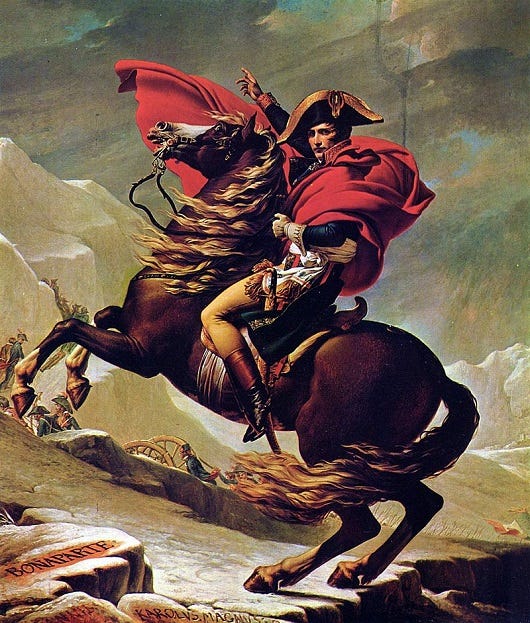
First, let’s establish who we’re talking about here. JLD* was a French painter who spanned the 18th and 19th centuries. His most prominent period overlapped with the French Revolution and the Napoleonic Wars. He was a tremendously gifted technical painter, as you can see here:

*Using “JLD” occasionally here just because typing his whole name out over and over is a drag. But the abbreviation feels weird, because I usually associate it with Julia Louis-Dreyfus, who has this mirror-image thing going by being as absolutely cool as David is sucky. Nature always balances out, I guess. Oh, while we’re all parenthetical, maybe this is a good place to point out that, being French, his last name is pronounced “Dah-veed.”

Continue reading You Know Who Sucks? Jacques-Louis David

Culture From Below in 2020 (and 2026, FWIW)

This post is part of my ongoing project to migrate my old Art Is My Middle Name newsletter archives to my own website. Learn more about all that.

This one in particular was an urgent outburst in 2020 but you know what? I’ll stand by it in 2026, and think it’s all the more urgent. Just, uh, don’t use Substack now.


Originally published Jan. 16, 2020

Hey, there,

This began as a twitter rant the other day, and it kind of took off, much to my gratification. But Twitter is ephemeral, and I want to spread this message as far as I can. In fact, to that end, after you read this, please forward it to anyone who might be receptive.

OK, then.

*clears throat*

I have an earnest request for you (yes, you).

Start a blog in 2020! And start reading other peoples’ blogs!

RC and I were talking the other night night about how much it sucks that our society just drifted away from blogs after the big social media sites sprung up. I understand the historical reasons for this, but here’s the thing: NONE OF THOSE REASONS ARE DETERMINISTIC OR IRREVERSIBLE.

There used to be this wild, varied, untamed wonderland of personal expression through blogs and it was a thing of exquisitely messy human beauty.

Now, we all complain (rightly!) about the slow death of media outlets, especially those that have any spark of humanity in them. And we howl (rightly!) about how the big social media orgs, especially FB, are trying to turn the web back into a monetized AOLesque walled garden.

And those things are true, and they suck!

BUT A HUGE SUITE OF BLOGGING* TOOLS IS STILL JUST OUT THERE WAITING FOR ALL OF US TO PICK THEM UP, USE THEM, AND GIVE OURSELVES OUR VOICES BACK.

*and newslettering, which winds up being functionally damn near the same thing.

Writing for paying outlets is great if you’re interested in pursuing that, but there are always fewer of them, and you have to tailor your pitches to their tastes and the news cycle and what have you. And that’s fine, but THERE’S SO MUCH YOU HAVE TO SAY THAT DOESN’T FIT INTO THOSE BOXES.

And it’s intimidating to pitch stuff, and it sucks to get rejections. SO WRITE ABOUT WHAT INTERESTS YOU ON YOUR OWN BLOG WHERE NO ONE’S GONNA SAY NO TO YOU. YOU HAVE A VOICE AND IT’S AS IMPORTANT AS THE LATEST GODDAMNED BACHELOR RECAP ON A CORPORATE SITE.

Let your freak flag fly! Write about the weird shit that interests you! Not sure about your grammar or spelling? WHO GIVES A DAMN ABOUT YOUR GRAMMAR OR SPELLING? You still have things to say.

And then let the rest of us know about it! And on the flipside: we all can and should make an effort to be reading each other. Committing to this for 2020: I’m going to forcefully push to add idiosyncratic personal blogs back into my media diet.

I just got done reading* a book about kids in a fucking police state using darkrooms and silver nitrate to photo-reproduce newsletters to give themselves a voice; we’re all sitting here with the best communication system IN HUMAN HISTORY sitting in front of us unused.

*and won’t stop talking about, apparently

Google Reader died? WHO CARES? Every goddamned browser has a bookmark function. Or it’s not hard to type a URL.

If you don’t want to mess with blog software: start a newslettter! Then nobody has to remember to check your site; they just have to check their email. It took me less than 20 minutes to set up Art Is My Middle Name. It could not be easier.

So yeah. Start a blog, start a newsletter, and let everyone know about it so we can signal-boost it. And if you can boost your friends’ signals, DO IT.

OK, that’s it. Sorry about the shoutiness, but I feel strongly about this. Please at least give starting a blog, about whatever you feel like talking about, a serious think, and forward this to anyone who might be open to the same.

Newsletter’ll be back, maybe in a couple of weeks, in a more restrained form.


RECOMMENDATION

I recommend that you start a blog or a newsletter, and then let me know about it.


CLOSING STUFF

OK, so here at the bottom, sorry for the ragged copy editing; my deal with myself was to keep this fast and loose, which is gonna mean typos. On the other hand, that also means it’ll actually come out, instead of being obsessed over.

If you have any thoughts/reactions/what have you about this, I’d love to hear about it, either by email or on Twitter. And if you know anybody who might dig this, please forward it on to them, or send ‘em the signup link! And thanks!

This Newsletter (/website) Has Been Hijacked by East German Punks

But don’t worry, they’re pretty positive once you get to know them

This post is part of my ongoing project to migrate my old Art Is My Middle Name newsletter archives to my own website. Learn more about all that.


Originally published Jan. 14, 2020

Hey, there,

The plan was for this issue to be about what it actually means to have refined taste, which is a bee that’s been in my bonnet for a while. But then I got sucked into Burning Down the Haus, Tim Mohr’s book about punks in East Germany in the 70s and 80s, and that thing took over my whole brain. Refined taste is gonna have to wait.

Haus is fascinating, relevant, and moving from like 30 different angles (to me, at least, although a book about politically-active bands and punks in East Germany does sound like something developed in the lab to appeal as tightly to as many of my interests as possible). But the thing I want to focus on right here is a fundamental thing undergirding the book and the world its describing: the way that punk culture created a space through which East German kids could assert their own identities in a system that was geared to suppress identity (and for what it’s worth, I’d say the same thing is true about punks on the other side of the Iron Curtain, the difference being lower stakes and some details in how the overarching system tries to assign you an identity that’s convenient for its driving ideology).

Continue reading This Newsletter (/website) Has Been Hijacked by East German Punks

Bluebeard!

This post is part of my ongoing project to migrate my old Art Is My Middle Name newsletter archives to my own website. Learn more about all that.


originally published Dec. 29, 2019

Hey, there,

So I want to start out my talking about art by talking about a book (which is largely about art): Kurt Vonnegut’s Bluebeard. It’s not quite top-shelf Vonnegut, but it’s pretty good and certainly doesn’t deserve its obscurity. And as far as my life goes, Bluebeard was a big turning point in letting the idea of capital-a Art establish a beachhead in my brain.

Bluebeard is ostensibly the autobiography of Rabo Karabekian, a fictional Armenian-American Abstract Expressionist painter who became a national joke when the “futuristic” materials he used to create his paintings causes them all to fall apart. There’s a lot going on in Bluebeard, with time spent on the Armenian genocide and some admirable-in-intent-but-kind-of-falling-short-in-action feminist points being made, but the stuff that always stuck with me the most was “Karabekian” just addressing the reader and talking about painting and paintings (and since Vonnegut painted on the side, I don’t think it’s too outré to just read these sections as Vonnegut telling you what he thinks about painting).

Continue reading Bluebeard!

A LIFE IN FILM #20 – GROUNDHOG DAY

A Life in Film is a project where I’m writing about a movie from every year I’ve been alive.

1993: Buddhism and Also the Murray Problem

GROUNDHOG DAY (dir. Harold Ramis)

TRACK 1: BUDDHISM, SORT OF

They say that as you get older, you think about religion more. And maybe that’s true, or at least sort of true. I’m definitely older (why, I’m two years older than the last time I posted to this project), and I know that as time goes on, my thoughts get more and more existential. Not religious, really, because I have a hard time with supernatural beliefs. But definitely with an eye on to the bigger picture of existence and where I (/we) fit in and what’s going to happen when I’m not here anymore (mostly, I want to make sure my musical gear goes to somewhere it’ll get plenty of use).

I was raised Catholic, more or less, but it didn’t take; part of that was that my parents’ hearts weren’t really in it (which is fine). I was pretty much done with it, and Christianity, by the time I was driving. But I had a weird childhood, and in a very real sense I was raised in two households. And that second household was heavily influenced by a professor of comparative religion with a particular interest in India who had an active if idiosyncratic personal religious practice that sort of mixed Buddhist thought and practice with American Midwestern Lutheran culture.

I guess what I’m saying is that, while I can’t at all claim to have raised as a Buddhist (or, to be clear, to have any real sense of what a personal Buddhist practice is like outside of some very unusual conditions), I was at least out on the right end of the bell curve in terms of exposure to Buddhist concepts among teens in rural Nebraska in 1993. Cycles of rebirth and improvement within them, sure, yeah, weren’t we talking about that at dinner the other night?

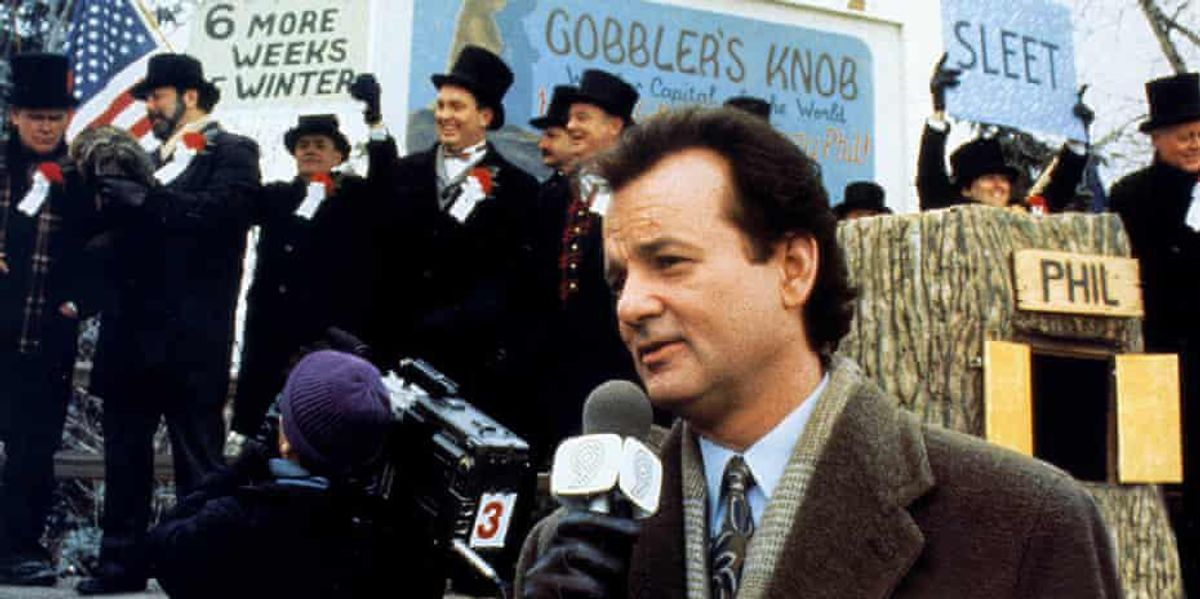
Phil Connors, reporting live from a world of suffering

So, Groundhog Day landed pretty well in that second household of mine. Bill Murray’s asshole weatherman relives a day over and over and over, passing through waves of hedonism and nihilism until he improves himself and learns to accept his feelings in the moment, and is released from the cycle.* The resonance is right there out in the open (the lore about the script is a little muddled, with stories both crediting Harold Ramis for strengthening the Buddhist parallels, and faulting him for downplaying them, to the detriment of his relationship with Murray; in the end, it matters less how they got there than that they’re there).  

Continue reading A LIFE IN FILM #20 – GROUNDHOG DAY

BE A GODDAMNED HUMAN: AN ART-MAKING MANIFESTO

0.  What are we doing here?

Bottom line: I’m trying to get you to make art. Art within a very broad definition of what constitutes art. Messy human art. Art that might not make you any money (although it might! It doesn’t really matter either way!), but will make you feel better just for having made it.

I don’t want to center myself here, but if I’m going to say all of this, I feel like there’s some use very briefly establishing my background. So: I’m a multidisciplinary artist (and we’ll get to what’s “art” pretty quickly), and have been for over 30 years. My fields are writing, comics, drawing, and music. I’ve never made my sole living on art, but I have been paid for it and a couple of my comics projects have been covered by Twin Cities media outlets. I also have an M.A. in art history from the University of St. Thomas, with a thesis project about self-published comics. So: it’s certainly possible that what I say in this manifesto is wrong, but it at least all comes from direct experience and years of thought.

Continue reading BE A GODDAMNED HUMAN: AN ART-MAKING MANIFESTO

A LIFE IN FILM #19 – SINGLES

A Life in Film is a project where I’m writing about a movie from every year I’ve been alive.

1992: Let’s not even talk about the weird Xavier McDaniel joke

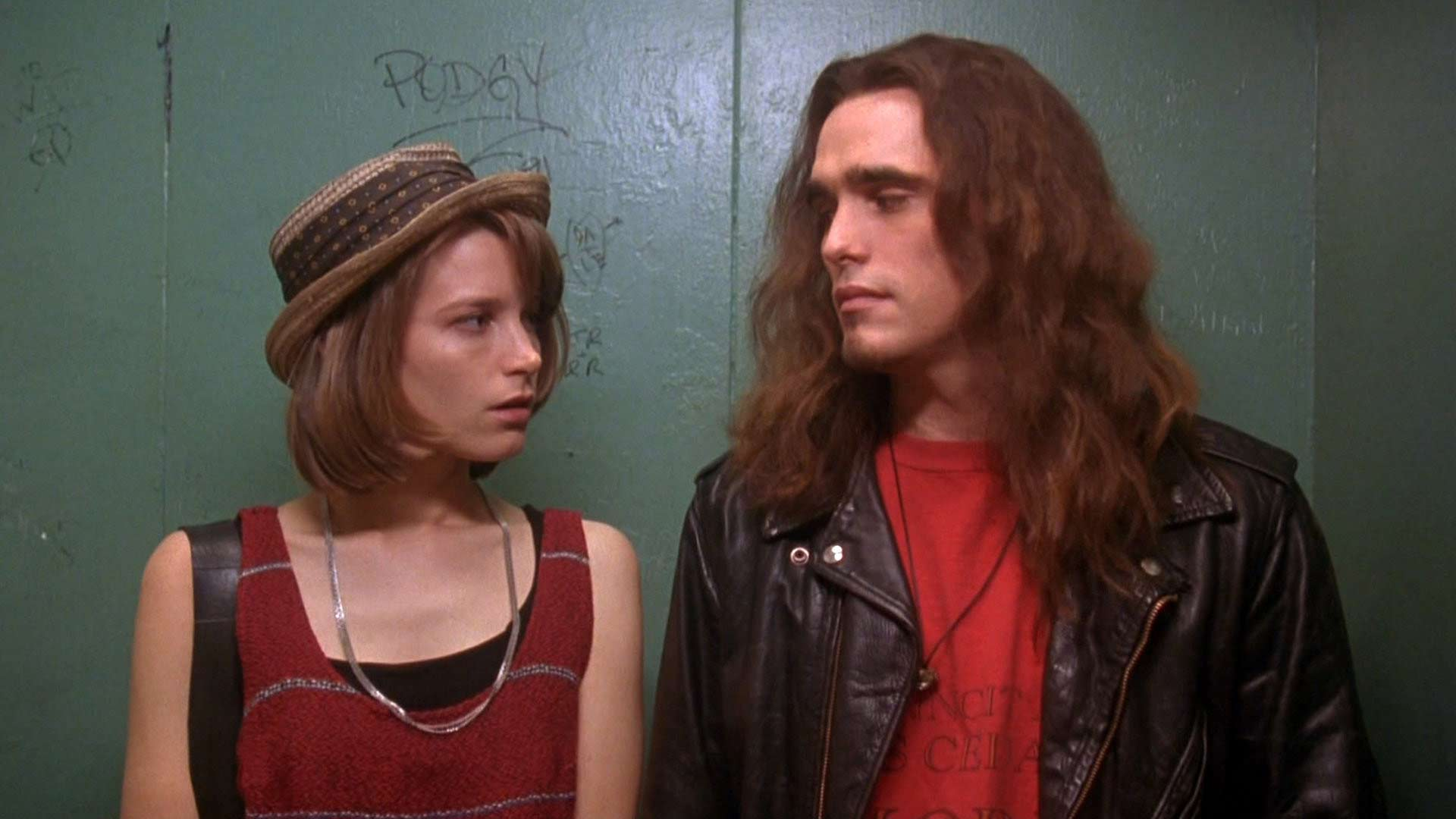
SINGLES (dir. Cameron Crowe)

I don’t know what it’s like to grow up as part of any generation other than X. Maybe the oldest Millennials, since I often find my cultural sympathies lining up with those a little bit younger than me. But that’s it. Like all of us, I’m a product of my time.

Which, in my case, means that I was starting to assemble the first draft of my adult self during the stretch when Singles had its weird little supernova interlude. I don’t know that it was a movie that meant much to, say, 40-year-old lawyers or even 17-year-olds who were thinking of joining the Air Force after they graduated; but among the nerdy, music-centered college-bound youth cohort that I was part of, this thing blew up like a firecracker. Out of nowhere, and for a little while, this movie exerted a bizarre cultural gravity. Not nearly as widespread as Batman, but very intense in its niche. The only album I’ve ever experienced peer pressure around “when are you gonna get it, you lameass?” was the Singles soundtrack, which went on to spend a few years as a member of the 90s De Rigeur Dorm CDs Starter Pack.

You have to hand it to them as a couple: at least they could always share each other’s clothes

And that soundtrack album is tightly tied into the whole thing. The interplay between music and movie was a knot you couldn’t cut. They were conjoined*. The movie was noteworthy because of the soundtrack, which was noteworthy because it was so Seattle-heavy, which of course it was because this was a movie about music-loving folks in Seattle, which hey did you hear that Seattle is where things are happening right now? Anyway, Pearl Jam and Chris Cornell figure somewhat prominently in both movie and album.

*Consider the fact that the title of the movie itself is a triple entendre: singles as in single people, singles as in one-bedroom apartments, and—of course—singles as in music.

Continue reading A LIFE IN FILM #19 – SINGLES

A LIFE IN FILM #18 – THE COMMITMENTS

A Life in Film is a project where I’m writing about a movie from every year I’ve been alive.

1991: I’ve an arse here you can kiss.

THE COMMITMENTS (dir. Alan Parker)

tough to decide whose costume here is the most 1991

To repeat a sentiment I’ve used a lot in this space: The Commitments is not a capital-letter Great Movie, but in its low-key way it is a great little movie about music. It’s about the joy inherent to making music with other people, one of the great collaborative pleasures of life. And, equally, about the bullshit that can come along with it. Maybe bullshit’s too strong a word; friction’s better. Interpersonal disputes, technical problems, trouble booking shows, miscommunications, you name it—all the stuff that I spent years talking about (at roughly Commitments-level stakes) in Nowhere Band.

And the level of the stakes is important there. This Is Spinal Tap covered a lot of the same ground, but at a different level. For all that Spinal Tap’s career problems are central to whatever plot that movie has, they’re still big enough to play arenas (when they’re not opening for puppet shows) and release albums on major labels. The Commitments, on the other hand, are at ground level and they’re going to stay there. The Commitments’ world isn’t that different from the one the Awesome Boys navigate in Nowhere Band, or—not coincidentally—the real one my bands the Creekside Ruffians and Derailleur have moved through. It’s the world of bands that are never going to make anything more than beer money. And if that’s less glamorous than the world of pro musicians, it’s accessible and relatable, since it’s where most of us who own instruments are going to spend all of our time. It’s the reality of what making music is like for the vast majority of people making music. And it’s even still pretty aspirational, because, as the movie illustrates, it’s just a shitload of fun to play instruments and yell with other people.

Continue reading A LIFE IN FILM #18 – THE COMMITMENTS

A LIFE IN FILM #17 – THE HUNT FOR RED OCTOBER

A Life in Film is a project where I’m writing about a movie from every year I’ve been alive.

1990: Dudes Rock Under the Sea

THE HUNT FOR RED OCTOBER (dir. John McTiernan)

To lean again on the autobio part of this project: The Hunt for Red October is another one that I’m not about to claim is great cinema (although as a really well-executed-more-or-less-based-in-something-resembling-the-real-world thriller, it’s maybe a great example of a type of cinema that I’d love to see more of in the modern era). But it’s a movie that appealed to a bunch of my interests when it came out, and maybe helped cement them as things that would stay on my mind for the long haul. And it’s also a ton of fun, which is nothing to sneeze at.

But those interests. This was, of course, the first film adaptation of a Tom Clancy book (FWIW, I feel like it’s by far the best Clancy movie, adapting his best book). I was at the time going through the kind of Tom Clancy megafan phase that only makes sense when you remember that it was before the internet and I was living in deeply conservative rural Nebraska and the pipeline for new-author discovery was, uh, limited. I’ve written at length about my difficult mental relationship with the works of Thomas Clancy, but at the time I thought he was better than Hormel chili and any movie adaptation was something I had to see.

Clancy’s books, including Red October, often center on the CIA, which was another major interest at the time. Of course, nerdy adolescent boys often get interested in spying; that’s nothing unusual. What made me different was that I damn well did something about it, going through a process that came pretty close to getting me a job at the CIA *and* getting me a very unfortunate hat from Structure (and yeah, this is a thing I mention at the end of the linked comic, but it’s worth mentioning here: given where my mind and politics went as the 90s progressed, I think it was best for both me and the CIA that the thing didn’t work out).

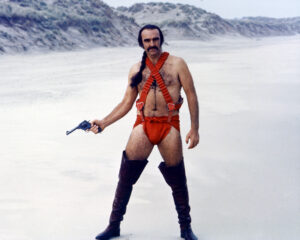
I have to assume that Connery enjoyed the costuming sessions for Red October a lot more than he did for Zardoz.
Continue reading A LIFE IN FILM #17 – THE HUNT FOR RED OCTOBER

A LIFE IN FILM #16 – BATMAN

A Life in Film is a project where I’m writing about a movie from every year I’ve been alive.

1989: Look. I’m sorry.

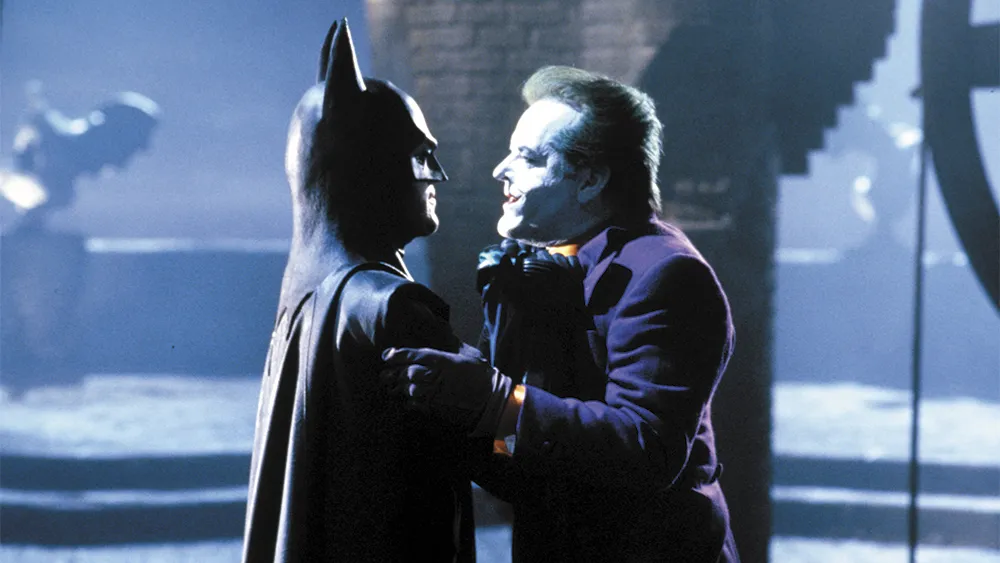
BATMAN (dir. Tim Burton)

I don’t know about you, but I’m pretty tired of superheroes on film.

But the thing is (*looks around*), this is all my fault. Well, mine and the fault of thousands of other people who had opinions about who the best writer for Superman was or what we’re supposed to take from the ending of Watchmen. We all thought “god, superhero comics can be cheesy, but they can also be so much fun, so resonant, and such fertile ground for metaphors that can really take you to interesting places looking at the real world! Wouldn’t it be great if everyone would wake up to this and get on board?” And then a monkey’s paw twitched, and a long fuse started burning, eventually leading to a world where everything at the multiplex was competing examples of CGI punchfest dogshit where all the life and humanity had been purged by a corporate assembly line filmmaking process.

This isn’t true, of course; or at least it’s not true in the sense that there weren’t actually any cursed monkey’s paws involved. But I do think that there’s probably some truth to the idea that the critical mass of comicsheads in the early 00s who all went and bought tickets to the first Nolan Batman movie, and to the Raimi Spider-Man movies, and the Singer X-Men movies, we were the accelerant that gave Hollywood in general and Disney in particular the idea that there was endless money to be made by quadrupling down on this superhero thing. It’s not just a thing that we let happen; it’s a thing that we cheered on at the time. And I don’t feel great about that.

Tracing definitive cause and effect in stuff like this is rarely possible, of course. But I feel like it’s reasonable to say that a lot of my cohort of 2000s-era young nerds with disposable income were all put onto this track just by living through the hype cycle for Burton’s Batman.*

*Purists will no doubt argue that the Donner-Reeves Superman movie was there laying groundwork a decade earlier, and that Superman and Batman had been showing up in movies since the 40s. And this is all true, of course! But subjectively, at the time, the Batman ’89 hype cycle felt different and more lasting, even if I’m just saying that from the center of the marketing-push blast zone.

I can’t find the citation now, but I read somewhere that at one point Nicholson said to Keaton something like, “a movie like this, you just sit back and let the makeup do the work.”
Continue reading A LIFE IN FILM #16 – BATMAN

A LIFE IN FILM #15 – A FISH CALLED WANDA

A Life in Film is a project where I’m writing about a movie from every year I’ve been alive.

1988: You’re a true vulgarian!

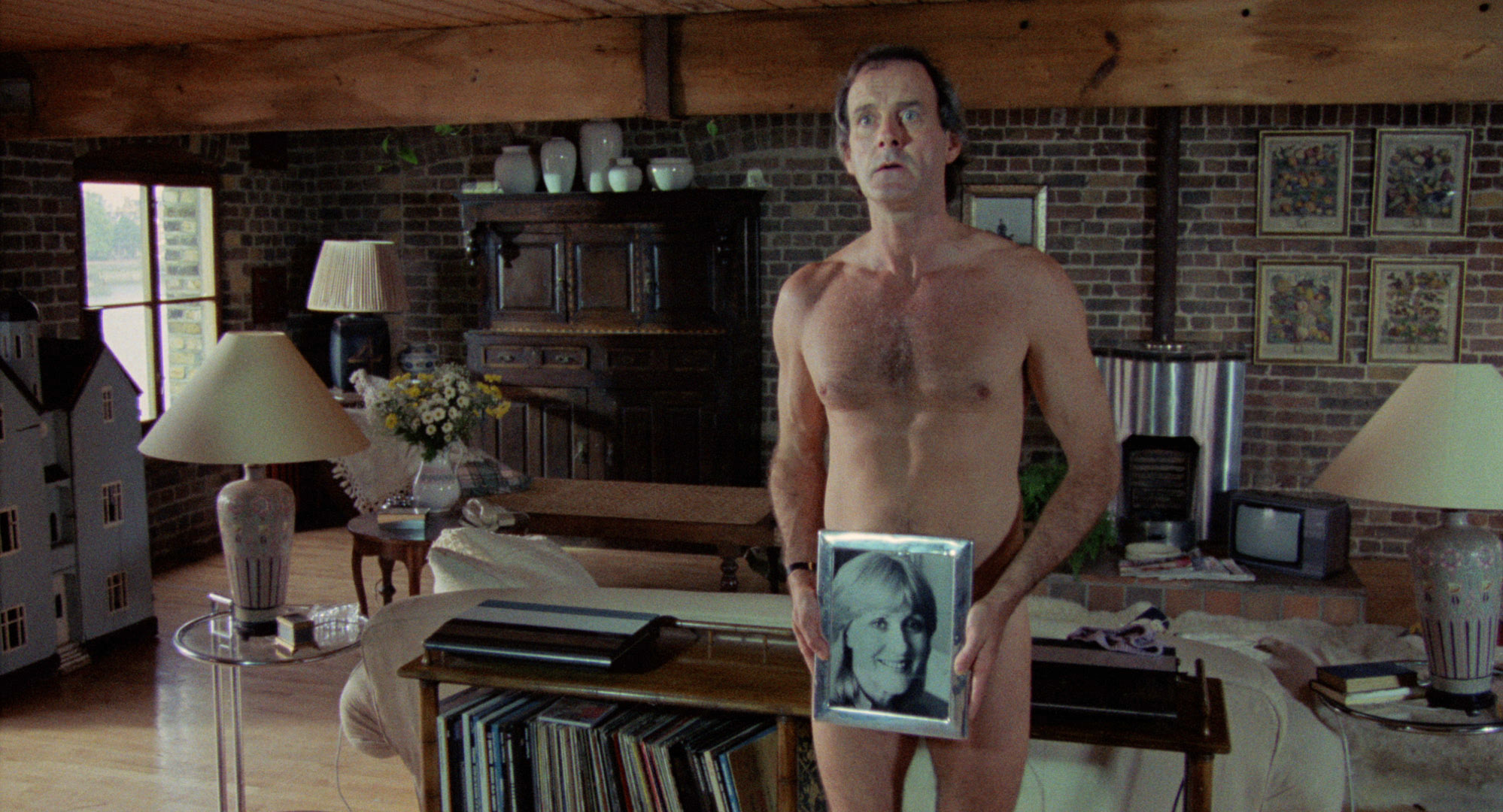
A FISH CALLED WANDA (dir. Charles Crichton and John Cleese)

Maybe this isn’t universal, but I think it’s pretty close, at least among musicheads: when we’re young, we think and expect that the bands we love are all best friends and communal life partners. Maybe they all live in a big house together, or at least wish they did. That’s the way it worked on The Monkees, right? So it must be real. And then, of course, to get a little older and start more serious learning about music is to come to understand that this pretty much is never how it works.

Monty Python weren’t a band, of course, but everyone I knew back in the 80s mapped the same sort of belief onto them. I have to assume that the culture has shifted significantly in the years since then, but when I was a kid it was just a given that a sizable minority of us were going to get exposed to Monty Python and the Holy Grail at a birthday party or sleepover and then have our minds totally colonized by the Pythons, leading to a feverish walk through their filmography (difficult but possible in the 80s, given VCRs and cable tv) and a general belief that they were the Most Important Thing Ever. And then we’d all realize that the Most Important Thing Ever didn’t seem to be putting out any movies after Meaning of Life, and we’d all wonder: what was wrong? Did they not love each other anymore? Had the band broken up? Oh shit, the band must have broken up!*

*For this to make any sense at all, of course, you have to remember that in 1986 there wasn’t an internet that you could pop open to look at a Wiki page. I don’t think anyone I knew would have had any idea back then how to figure out what the actual status of Monty Python was, beyond maybe asking our parents, who—remember, this is rural Nebraska here—wouldn’t have had a fucking clue.

All of which is to say: when I was in junior high and A Fish Called Wanda started creeping into my friends’ collective consciousness through the twin media of cable tv and video rentals, it was a big deal. New Python-ish stuff! Sure, it didn’t have all of them (and was it true that maybe one of them was dead?), but it had Cleese and Palin, and those were two of the bigs, and right fuckin’ on!

And now for something completely different…
Continue reading A LIFE IN FILM #15 – A FISH CALLED WANDA

A LIFE IN FILM #14 – RAISING ARIZONA

A Life in Film is a project where I’m writing about a movie from every year I’ve been alive.

1987: I’ll be taking these Huggies and whatever cash you got.

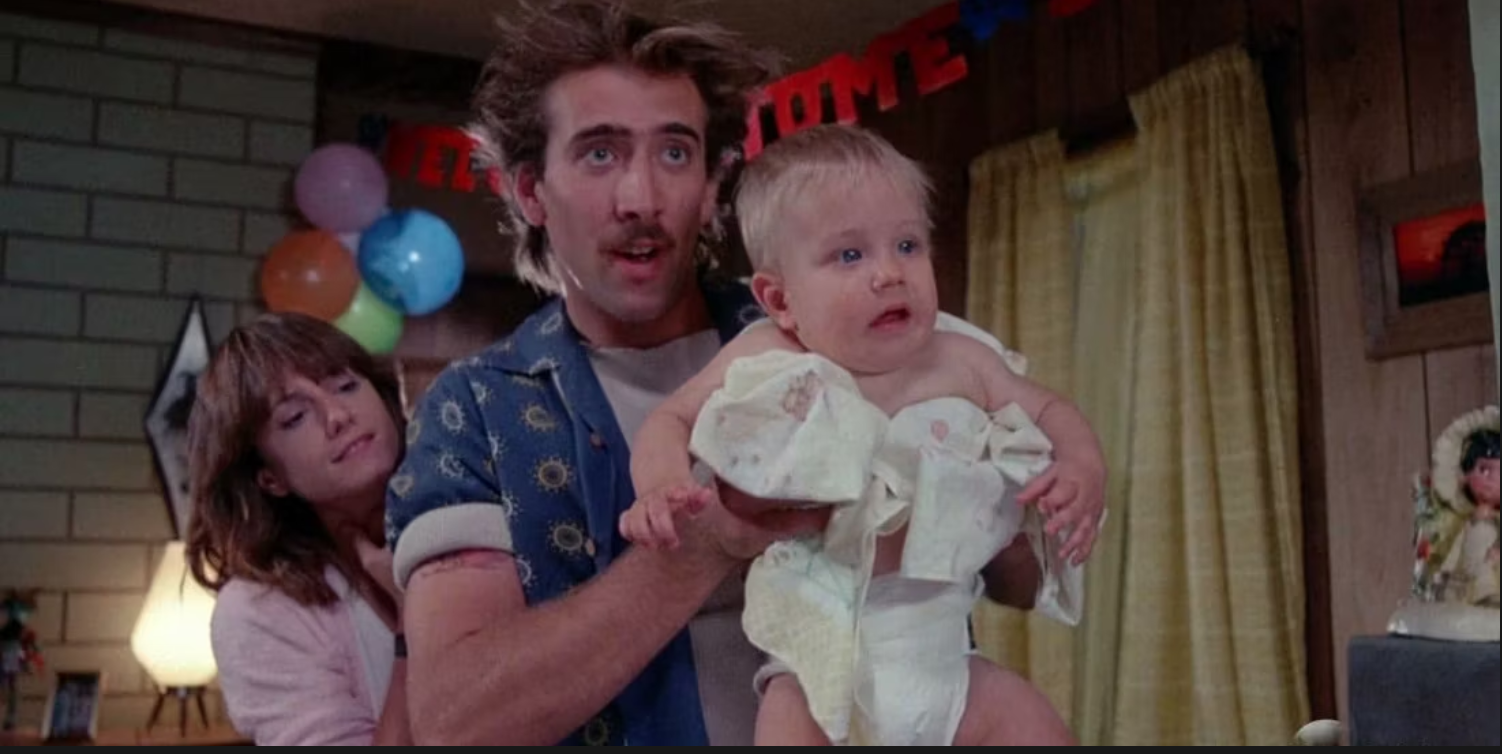
RAISING ARIZONA (dir. Joel Coen, officially, but come on)

I never want to lean too hard on the autobio side of this project, but in this case it’s really hard not to, at least a little. More than any other movie I’ve talked about, and on a couple of different axes, Raising Arizona was a movie that served as a gateway to other places and ideas. If you weren’t around in the 1980s, I don’t know that you can really appreciate what it was like to encounter Raising Arizona for the first time. I’ve probably said this sort of thing before, but it’s like 50 times as true for Arizona than it is for anything else.

There’s this body of discourse that floats around Bluesky pretty frequently about how the 80s weren’t the cool neon vaporwave retrofuturescape that gets held up with some frequency as a stand-in for the era, that it was actually a whole lot more beige than people try to pretend it was; and, as usually with a discussion like that, I sort of simultaneously agree and think it’s more complicated than that. But I think there’s a parallel argument to be had about 80s culture; we remember the good and the notably bad, but that memory of extremes really obscures the fact that most of what we watched, listened to, and read in the 80s was pretty boring, mid, and, well, culturally beige.

Actually, now that I think about it, the set decoration in Raising Arizona pretty accurately captured what the 80s looked like.

And I can promise you that in the cultural landscape of the Reagan era, damn few people were making unhinged live-action Looney Tunes cartoons that piled off-kilter dialogue, surreal action, and a lot of banjo-and-yodelling songs around a resonant emotional core. “What on Earth is this?” was the vibe the first time I saw Arizona. “I don’t entirely know what the hell’s going on, and I didn’t know you could do stuff like this in a movie, but I am into it.”

Continue reading A LIFE IN FILM #14 – RAISING ARIZONA

A LIFE IN FILM #13- THE TRANSFORMERS: THE MOVIE

A Life in Film is a project where I’m writing about a movie from every year I’ve been alive.

1986: A Ton of Bricks

THE TRANSFORMERS: THE MOVIE (dir. Nelson Shin)

And here’s another one that I’m not really about to call a great movie, or even a good movie.* ** But, to me at least, there are some ways that The Transformers: The Movie is an interesting movie. And if I’m reading my own concept for this project to indicate that I should be talking about movies that were important to me in their year (and I don’t always read it this way, but I definitely do sometimes), well this one couldn’t be more relevant; I think Return of the Jedi is the only other movie that came out within the timeframe covered so far that Young Me was as hyped about in advance as this one.

*And even if Transformers ’86 isn’t really a good movie, it’s far, far better than the Bay Transformers movies, or even its peer in late-80s animated toy commercialdom, the GI Joe movie.

**OK, but also: how hard must Jack Kirby have sighed whenever he heard that the big bad in this new movie was a godlike planet-eating space monster? Like, I know the Transformers movie and the comics were completely different things (and Kirby of course had no direct connection with either of them), but still, it’s all adjacent enough that he had to have heard about it at some point.

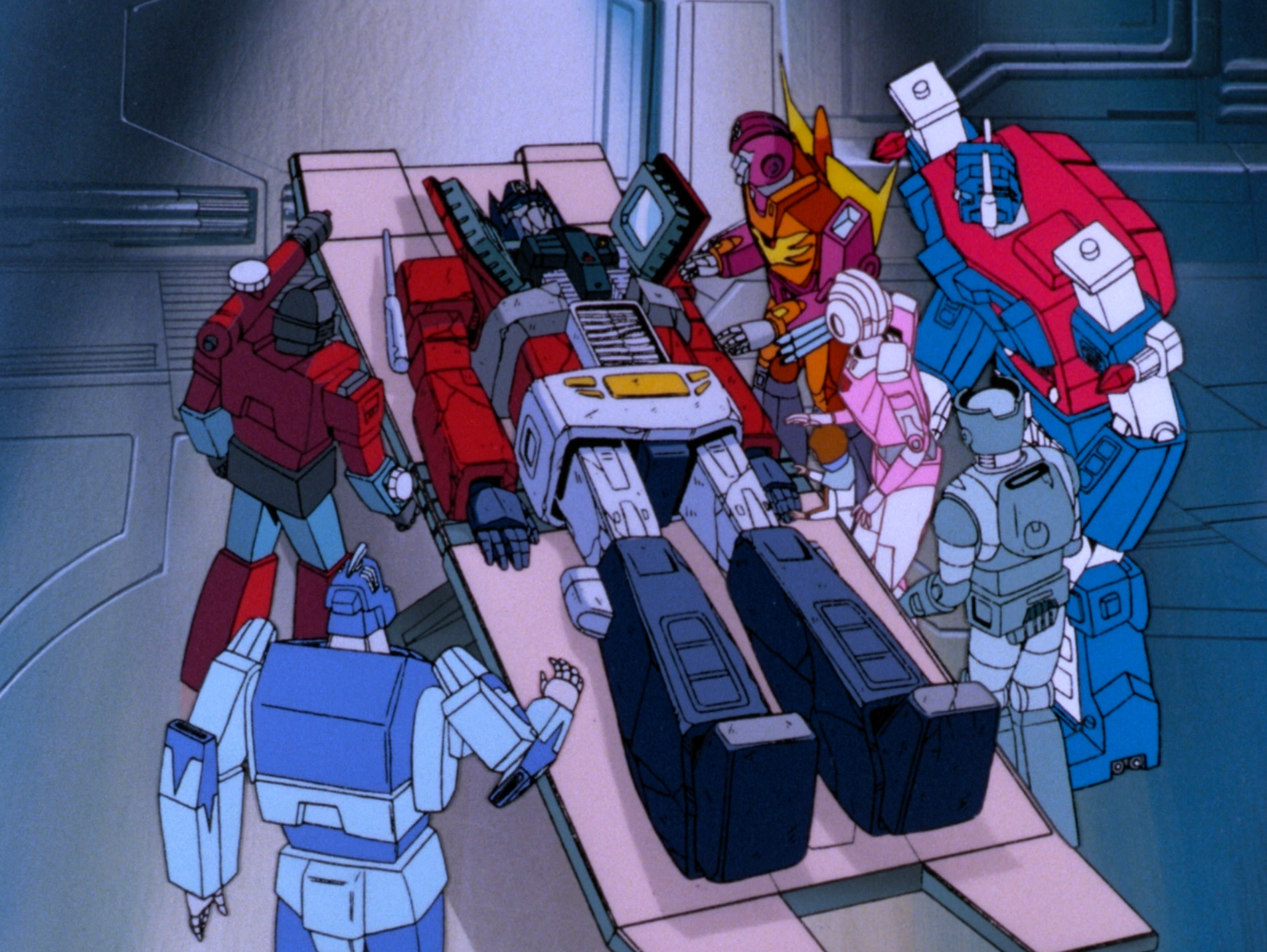
And I don’t think I’m alone in that; in fact, I think part of what does give Transformers ’86 a little bit of interesting heft in 2024 is that this fucker hit a lot of Gen X like a ton of bricks, and this was the cohort that would go on a few years later to start early-adopting the internet. One of my very first online experiences—aside from endlessly looking up people’s guesses at R.E.M. lyrics—was reading an extended, heartfelt post on some message board about how Optimus Prime and Megatron were archetypal figures while Rodimus Prime and Galvatron were flawed and “realistic” and this shift indicated a move from DC-style storytelling to Marvel-style and, well, I’m not saying this particular line of analysis is one that I’ve spent a lot of time on, but this type of analysis is going on more or less constantly in my head all the time and I think this goddamned post on Usenet or wherever is what kicked it all off. A bunch of us spent the 90s using this cool new interconnected web toy thing-o teaching ourselves to collaboratively dig through the semiotics of pop culture.

D-d-d-dad? Robot Dad? Are you ok?
Continue reading A LIFE IN FILM #13- THE TRANSFORMERS: THE MOVIE

A LIFE IN FILM #12 – BACK TO THE FUTURE

A Life in Film is a project where I’m writing about a movie from every year I’ve been alive.

1985: Things Have Turned Out Just Fine

BACK TO THE FUTURE (dir. Robert Zemeckis)

Let’s start by acknowledging something: I don’t know that there’s a ton I can say about Back to the Future as a standalone movie that hasn’t already been said. The discourse is pretty well-developed: it’s a beloved classic for a reason; it’s a great use of the talents of Michael J. Fox, Lea Thompson, Christopher Lloyd, and Tom Wilson; the bit about Marty teaching Chuck Berry about rock and roll is pretty problematic; one joke does lean a little too hard on the idea of Huey Lewis being a super loud rock and roller; and the timing of the climactic power-the-car-with-a-lightning-bolt scene makes no damn sense, no matter how exciting the scene is.

Oh, and the collected Freudians of the world must have collectively shit their pants when this movie came out and was a hit.

Anyway, rather than focus on the specifics of Back to the Future, I wanted to use the movie to pull back and talk more widely about a commonality I’ve noticed in a whole bunch of time travel movies. This, after all, is one of the most famous of the genre, and it’s probably the one that I’ve spent the most time thinking about.

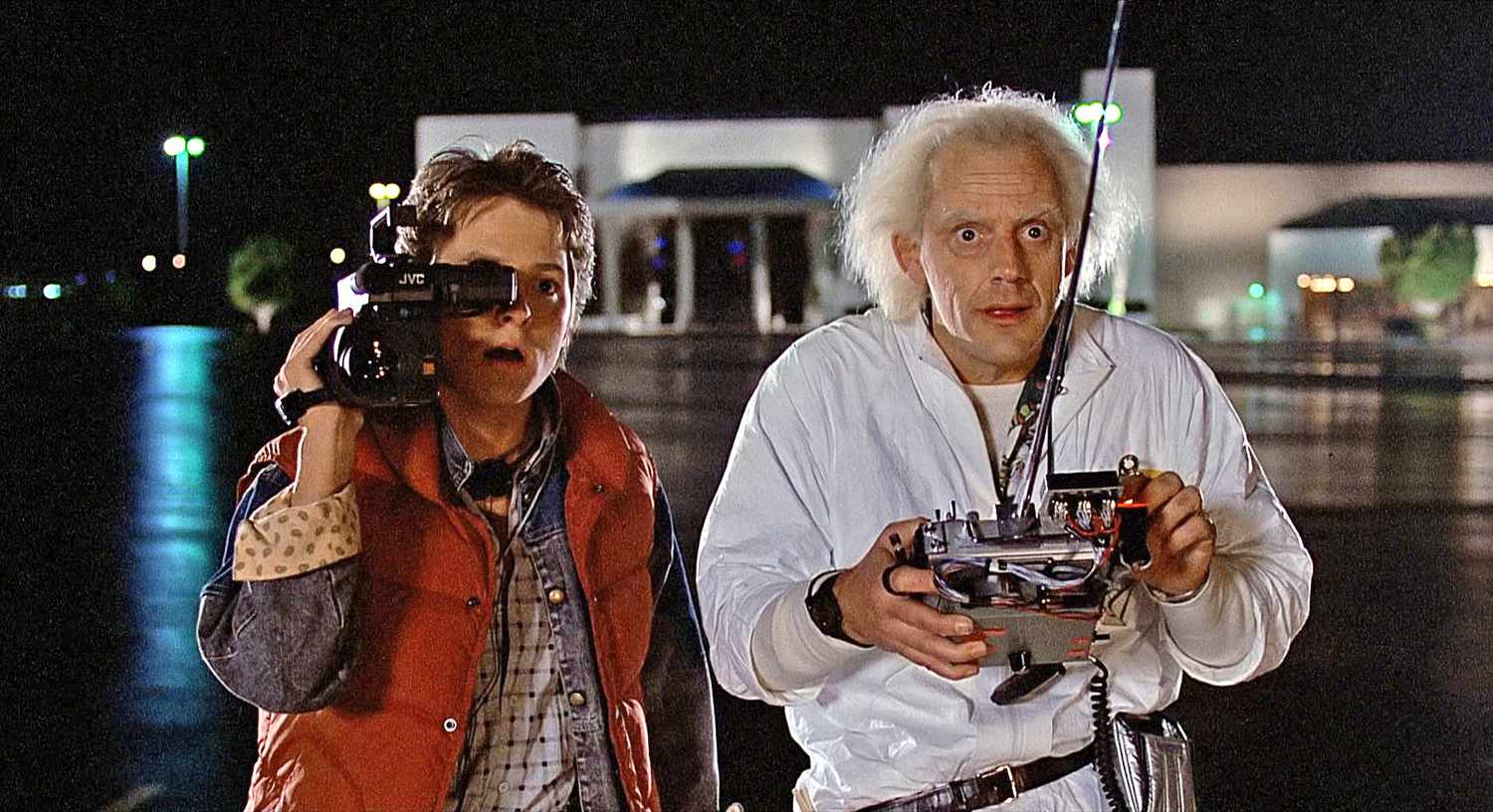
TFW you’re about to see some serious shit
Continue reading A LIFE IN FILM #12 – BACK TO THE FUTURE

A LIFE IN FILM #11 – THIS IS SPINAL TAP

A Life in Film is a project where I’m writing about a movie from every year I’ve been alive.

1984: Just a Bunch of Working Stiffs

THIS IS SPINAL TAP (dir. Rob Reiner)

Moving into double digits with this project, I can see a few patterns emerging. One of these is that there are a couple of situations where I’m nervous to do the writeup. If it’s a widely-loved movie that I’m not so crazy about, I get nervous, because I feel like I really have to make my case if I’m going to be critical, or I’m going to piss people off or look like an idiot. Conversely, if it’s a movie that I absolutely love, I get nervous because I don’t want to just gush, because I can’t be objective. I might piss people off or look like an idiot.

Because yeah. I love This Is Spinal Tap. I love it more than most other movies that I’d say I love. It’s an absolute pantheon movie, one of those handful where I feel like it makes some sense to view my life through a before-I-saw-this/after-I-saw-this lens. I love music so much that sometimes it makes me wonder about my own sanity; I think I first saw This Is Spinal Tap at about the time this truth about my brain was making itself known to me. This Is Spinal Tap is magical because it manages to simultaneously be insanely funny while also encompassing a world of truth about music, especially rock music, double especially the world of rock music in the late 20th century as that artistic era started to move into its baroque phase.

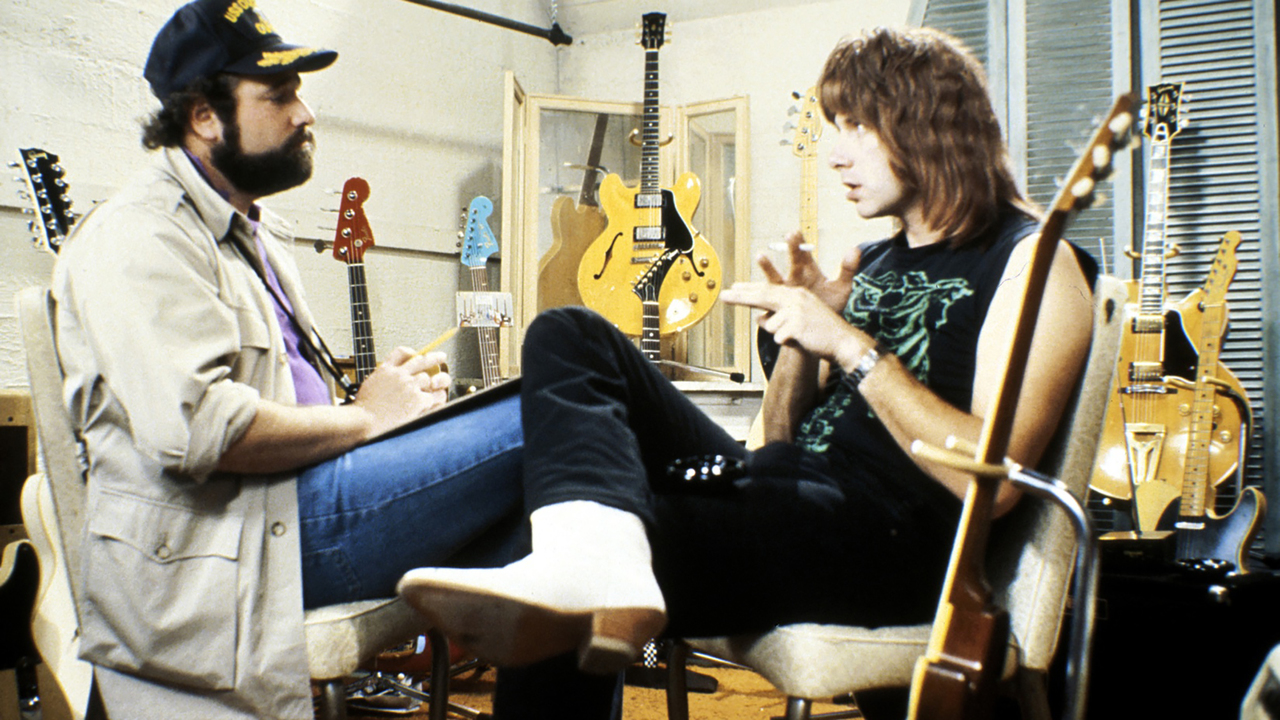
How great is Nigel’s shirt, though?

Let’s not kid ourselves: music is a little absurd on several levels, if you step back and look; and so is our love for it. What is music, really? It’s air vibrating in specific patterns. That’s it. To love music is to have really strong opinions about how you want the air around you to vibrate. That, I submit, is a pretty absurd foundation on which to build.

Continue reading A LIFE IN FILM #11 – THIS IS SPINAL TAP

A LIFE IN FILM #10 – THE RIGHT STUFF

A Life in Film is a project where I’m writing about a movie from every year I’ve been alive.

1983: The Perils of Adaptation

THE RIGHT STUFF (dir. Philip Kaufman)

With some of these, I get very nervous about doing the actual writeup. And this is very much one of those. Because no matter how much I want to—and I want to pretty badly—I just don’t like this movie very much. And I know it’s a (partial) consensus classic, and it feels weird to go against the consensus. But I can’t help it! No matter how much other people like it, no matter how much it involves people I like, concepts I like, and adapts a book I like, I just can’t really get with The Right Stuff. I don’t hate it, but, except for some individual sequences (and maybe one of the ongoing storylines), I can’t get better than lukewarm about it.

For me, what hobbles The Right Stuff is that the movie doesn’t know what it wants to be. Kaufman and William Goldman famously fought over the screenplay, with Goldman eventually leaving and washing his hands of the matter. And that unresolved fight is still present on the screen, giving us a long movie that meanders, bounces wildly in tone, and lacks focus. Goldman wanted to focus on the Mercury 7 and the patriotic hoopla around them; Kaufman wanted to focus on Chuck Yeager and the cult of tough-guy pilot machismo around him. In practice, even though Goldman bailed, we get an undercooked Mercury 7 movie stuffed inside a pretty good, tight dramatic short about Chuck Yeager. I talked a minute ago about feeling like I’m swimming against the current on this one, but I’m not completely alone; my understanding is that all of the surviving Mercury astronauts who saw the movie hated it (except for Scott Carpenter, who honestly seems like such a chill guy that he just liked everything). Conversely, Chuck Yeager supposedly loved it, but of course he would; the thing the movie most clearly succeeds at is making him look like the coolest guy who ever lived.

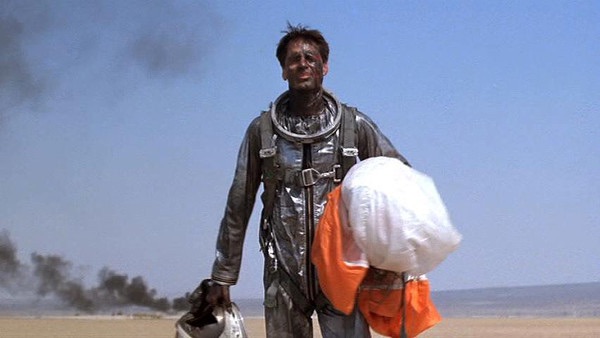
Sam Shepard as Chuck Yeager; since he’s walking away from that landing, it is by the accepted definitions a good one.
Continue reading A LIFE IN FILM #10 – THE RIGHT STUFF

A LIFE IN FILM #9 – STAR TREK II: THE WRATH OF KHAN

A Life in Film is a project where I’m writing about a movie from every year I’ve been alive.

1982: I Feel Young

STAR TREK II: THE WRATH OF KHAN (dir. Nicholas Meyer)

As this project itself will tell you, I was born at the end of 1974. It’s 2024 now; you can do some math (actually, doing the math will trick you, because I was born on one of the very last days of 1974, so usually it works better if you just assume ’75. Anyway. Close enough). I suffer from Crohn’s Disease in a way that, although it responds pretty well to medication, does mean that periodically my knuckles swell up and my hands in general just kind of say “I don’t feel like doing that.” RC and I took a vacation in January of 2020 and wound up taking a lot of pictures; in those pictures, I look like I could pass for late-30s. Of course, covid kicked off right after that, and if I look in a mirror and compare it to those pre-covid pics, I see a lot more gray hair, some permabags under my eyes, and generally a guy that absolutely no one would look at and think was a day younger than 49.

In other words: a lot of time these days, I feel kinda old. Not super old, mind you. But getting there (don’t worry, I’m fine). And this, of course, just makes me love Wrath of Khan even more.

I ask you: is that the chest of an old man?

Somehow, almost all of the original-cast Trek movies are in some way about grappling with middle age or beyond (I suppose this is probably just because the cast itself was aging; just looked it up and I’m currently just a touch younger than Shatner was when he made Khan, although I’m older than he was when he was worried about being old and out of touch in Star Trek: The Motion Picture).* Of all of them, Khan always did the best at grappling with the question of middle age, probably because it nests the question into a crackling story of adventure at sea that happens to be in space. Set aside the sci-fi trappings, and Khan  is Hornblower in Space, executed extremely well.

Continue reading A LIFE IN FILM #9 – STAR TREK II: THE WRATH OF KHAN

A LIFE IN FILM #8 – THE ROAD WARRIOR

A Life in Film is a project where I’m writing about a movie from every year I’ve been alive.

1981: He’s a Reasonable Man!

THE ROAD WARRIOR (dir. George Miller)

1.
Around 1940, a kid from central Iowa named Art Pille became a baseball phenomenon. He—according to family legend, at least—was invited to try out for the Cubs, but got a Luke Skywalker-style kibosh from his father, who needed him to stick around on the hog farm and help out for another season or two. Later events would make it clear that his fire for baseball didn’t go away, but any future he might have had with the Cubs got scotched by Pearl Harbor and the United States’ subsequent entry into World War II.

Pille was drafted into the Army and trained as an aircraft mechanic for the Army Air Corps. He was posted to Australia as a small part of the massive organization Douglas MacArthur was assembling to retake the Western Pacific. Stationed in Brisbane in a logistical support role, Pille had time to meet a local girl. They got married; he stuck around for a while after demobilization and played some baseball in Australia (I still have a Sydney Truck and Tractor replica hat somewhere in my basement) before they moved back to the US and started a very large family, creating a small but fervent pocket of Australian national pride in eastern Nebraska.

2.

It’s 1983. I’m sitting in Mrs. Gardner’s 3rd grade class in Blair, Nebraska, about 25 miles north of Offutt Air Force Base, which sits on the south side of Omaha. Mrs. Gardner is, for some goddamned reason, telling a room full of third graders that Offutt is the headquarters of something called the Strategic Air Command and that, if there was a war, it would be a big target for the Soviets and everything around us would get blown up. That’s a scary thing, she acknowledges, but we should also be proud to live next to such an important place. Speaking subjectively, sitting there at my desk I feel more of the scary side of that than the proud side of that.

3.

So, with all of that established, maybe you can see why I was primed for The Road Warrior to smash into my brain as the Most Important Thing Ever when I first saw it during its run of endless screenings on HBO.* An Australian movie!!! About life after nuclear war!!! Holy shit!!! Plus, and this is important, it’s the result of one of the greatest filmmakers in history fully hitting his stride. It hit me like a ton of bricks when I saw it—stop me if you’ve heard this one—way too young, and I’ve never stopped loving it. Between The Road Warrior and INXS, the mid 80s were a great time to have a lot of Australian pride, and I don’t care how many Crocodiles Dundee you wave in my face.

Continue reading A LIFE IN FILM #8 – THE ROAD WARRIOR

A LIFE IN FILM #7 – THE BLUES BROTHERS

A Life in Film is a project where I’m writing about a movie from every year I’ve been alive.

1980: On a Mission from God

THE BLUES BROTHERS (dir. John Landis)

In general, I’m a little nervous about doing these writeups about movies I love, because if someone’s going to take the time to read one of these, I don’t want to waste their time with endless “OMG IT RULES!!!!” 1980 poses a tough challenge, though, because the obvious movie to talk about is The Blues Brothers, and it happens to be not just a movie that I love, but one that I love so much that I think some of its themes are implanted into the wiring of my head.

Luckily, I do think there’s some interesting bigger-picture stuff to talk about here. Theology, cultural identity, that kind of fun stuff.

Twitchy, weird Aykroyd is the best Aykroyd

There’s probably no need to do a close rehash of The Blues Brothers; if you’re reading this, I assume you’ve seen it (and if you haven’t: you should!). But there are a lot of top-level things to note about it! For instance, it’s the first (and by far best) case of a Saturday Night Live bit becoming a movie. It features John Belushi and Dan Aykroyd doing maybe the best work either of them ever did. It’s about a couple of white weirdos* who love Black music, and believe they’re on a divine mission to use the power of music to save the orphanage where they were raised. It is itself a musical!

*It’s never made clear, as far as I can tell, if we’re supposed to consider them biological brothers or if they just have a sort of spiritual/musical brotherhood; maybe that doesn’t matter, and maybe that’s another point the movie’s making, intentionally or otherwise. And, of course, a couple of white guys who are trafficking so heavily in Black-coded culture referring to themselves as “brothers” is certainly a loose thread to be tugged at endlessly.

Continue reading A LIFE IN FILM #7 – THE BLUES BROTHERS

A LIFE IN FILM #6 APOCALYPSE NOW

A Life in Film is a project where I’m writing about a movie from every year I’ve been alive.

1979: A Place Where Americans Go and Stuff Happens to Them

APOCALYPSE NOW (dir. Francis Ford Coppola)

First off, and this is all I’m going to say on the matter: this movie represents the one situation where the music of the Doors is unambiguously good and awesome.

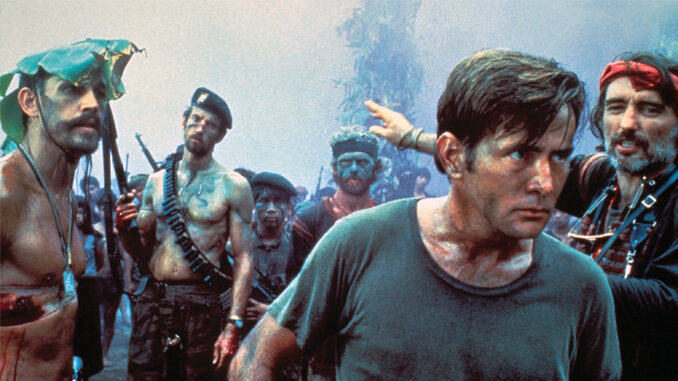
I’ve always assumed that this is what Dennis Hopper was like pretty much all the time

OK. With that out of the way: 1979 offered up a bumper crop of interesting, great movies! But there was always only one I was going to talk about. Apocalypse Now isn’t just a great movie, it might be the greatest American movie. It is not, however, the great Vietnam movie*; just sit with that for now, we’ll get there.

*That, obviously, is Return of the Jedi

I’m always conscious that I fully came online as a movie-watching adult with critical faculties some time in the 90s (I can peg it between the time I saw Fargo on initial release and didn’t get it at all** and when I saw it the second time, got it, and loved it). Before then, I still watched a lot of movies, of course, but for the most part they just kind of got piped into my brain un- or semi-digested. Apocalypse Now was definitely one of those. My parents had a copy as part of their enormous library of movies taped onto VHS***, and I watched it damn near constantly starting in 6th or 7th grade. I didn’t understand it at all—this is one of those movies where I was a voting adult before it really occurred to me to think about this as a movie with a plot and not just a series of cool scenes—but Young Me just *bathed* in the spectacle of this thing.

Continue reading A LIFE IN FILM #6 APOCALYPSE NOW

A LIFE IN FILM #5 – NATIONAL LAMPOON’S ANIMAL HOUSE

A Life in Film is a project where I’m writing about a movie from every year I’ve been alive.

1978: You Can’t Tell Me What To Do!!!!

NATIONAL LAMPOON’S ANIMAL HOUSE (dir. John Landis)

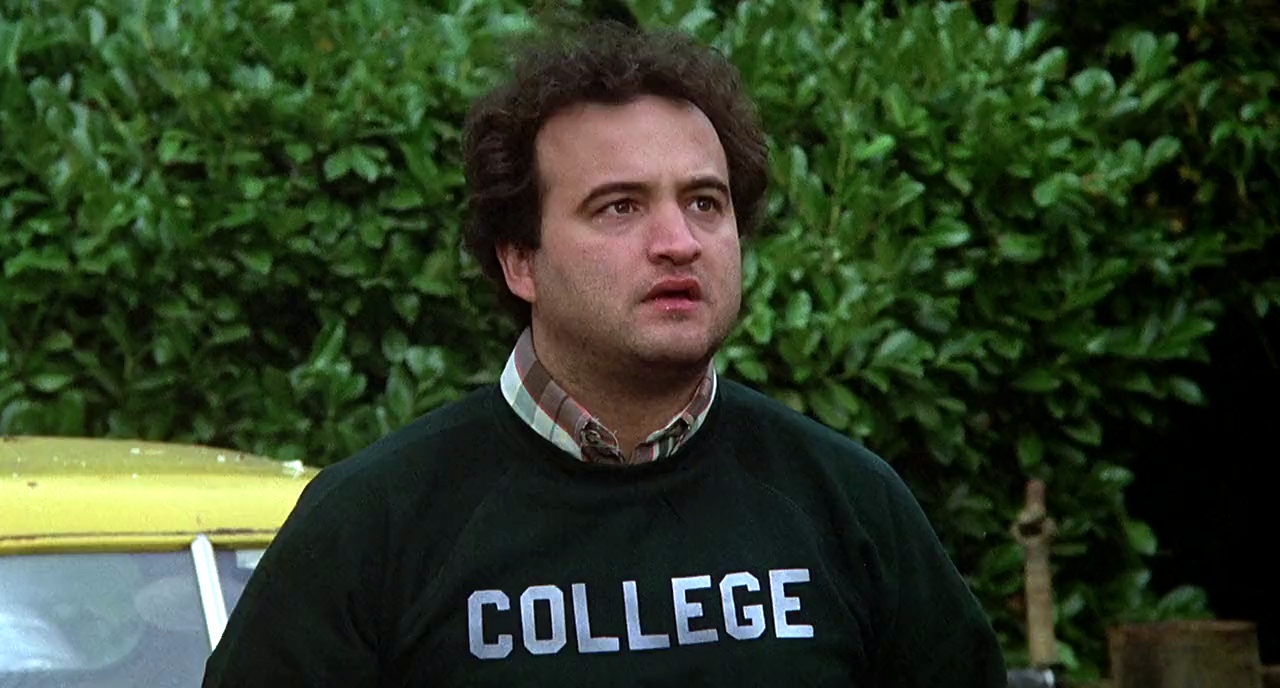
This shirt might be the best joke in the entire movie

A thing people love to say when they talk about movies (usually in the wider context of complaining how society is going to hell because the PC thugs/woke police/whatever is stifling us, maaaaaan) is that “this movie just couldn’t get made today.” And the thing is, that’s usually a completely useless observation. Social mores shift and culture changes. That’s natural; it’s always happened and it’s always going to happen until nature or human nature manages to kill us all off. Sure, maybe a studio wouldn’t greenlight Animal House to be shot with this script now; but at the same time, no studio would have come within 30 miles of Bottoms in 1978.

I guess my point is that the boundaries of what’s acceptable just naturally move with time, and movies move within that space. And more than that, comedies in particular exist within the specific cultural context in which they were made.* Comedy comes from breaking social norms, either shared or otherized, and those norms move with time.** Something that’s outrageous and boundary-pushing in 1955 might be completely unremarkable by 1980.

Continue reading A LIFE IN FILM #5 – NATIONAL LAMPOON’S ANIMAL HOUSE

A LIFE IN FILM #4 – SMOKEY AND THE BANDIT

A Life in Film is a project where I’m writing about a movie from every year I’ve been alive.

1977: YOU DON’T HAVE TO BE GREAT TO BE AWESOME

SMOKEY AND THE BANDIT (dir. Hal Needham)

Look, I’m not about to claim the Smokey and the Bandit is a great movie. It’s not. But it’s an awesome movie, and that’s nothing to sneeze at.

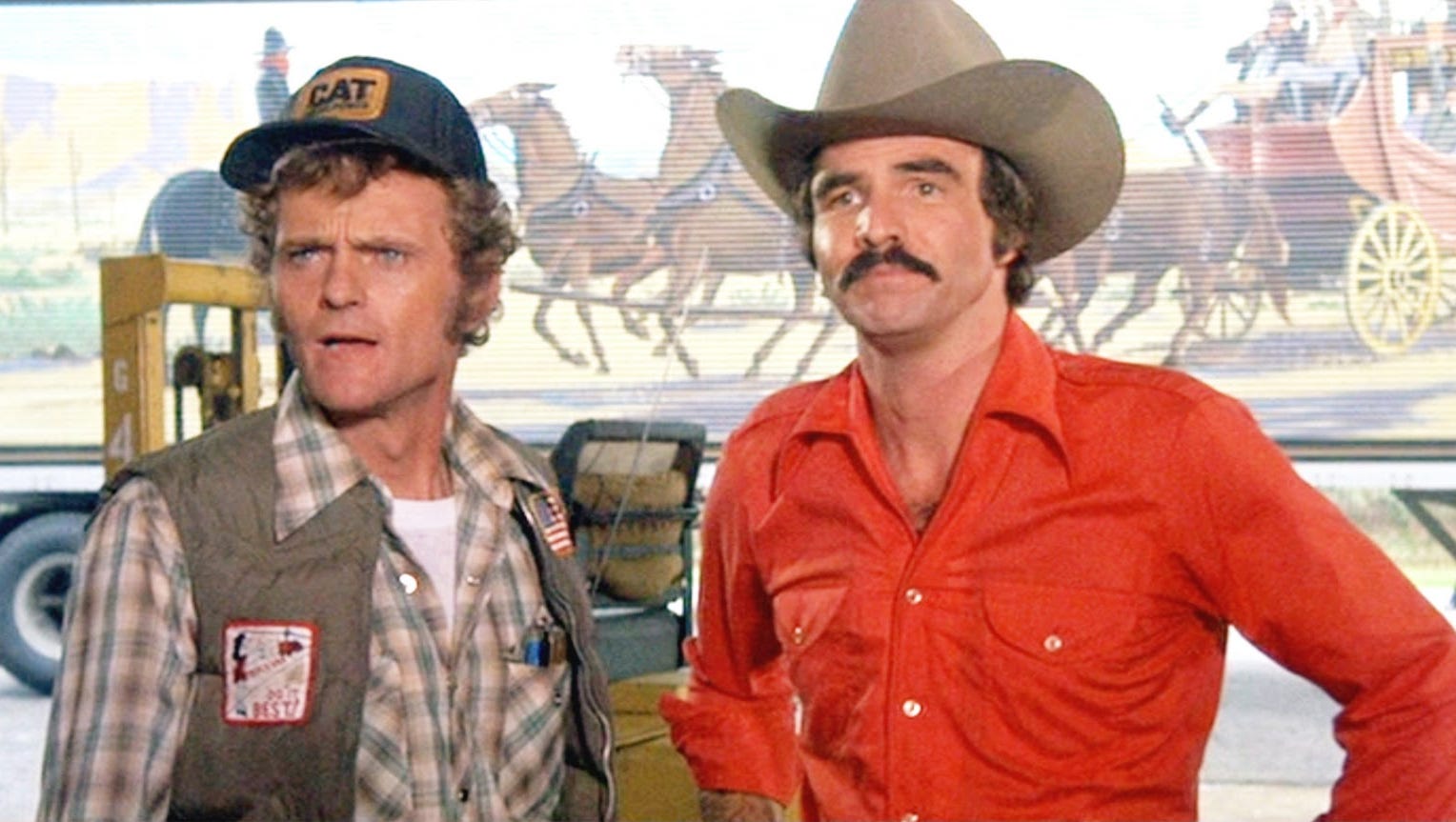
it’s called “fashion.” look it up.

Admittedly, “awesome” is a pretty subjective characterization, and in this case the case for awesomeness is helped a lot if you happened to be a little kid with access to cable television in the late 1970s and early 80s. And, well, guilty as charged. Bandit’s a very visceral, kinetic movie, all cool cars doing cool things and the triumvirate of Burt Reynolds, Sally Field, and Jerry Reed* radiating charisma; you can see why kids (and the general public) loved it. It’s a sort of golden retriever, all charismatic good cheer with no gravitas and no need for any.

*My only casting beef with this movie is that I don’t think much of what Jackie Gleason does is funny, although that’s OK because he’s the antagonist and he works fine in that role. I know most people don’t agree with me on this, but on the other hand I’m not entirely alone; a friend of mine mentions that he always found Gleason actively terrifying in the role.

Continue reading A LIFE IN FILM #4 – SMOKEY AND THE BANDIT

A LIFE IN FILM #3 – LOGAN’S RUN

A Life in Film is a project where I’m writing about a movie from every year I’ve been alive.

1976: WHAT CAME AFTER

Logan’s Run (dir. Michael Anderson)

Oh, Logan’s Run; a perfectly sort-of-adequate movie that accidentally serves as a very useful point of comparison to talk about another movie that came out 11 months later.

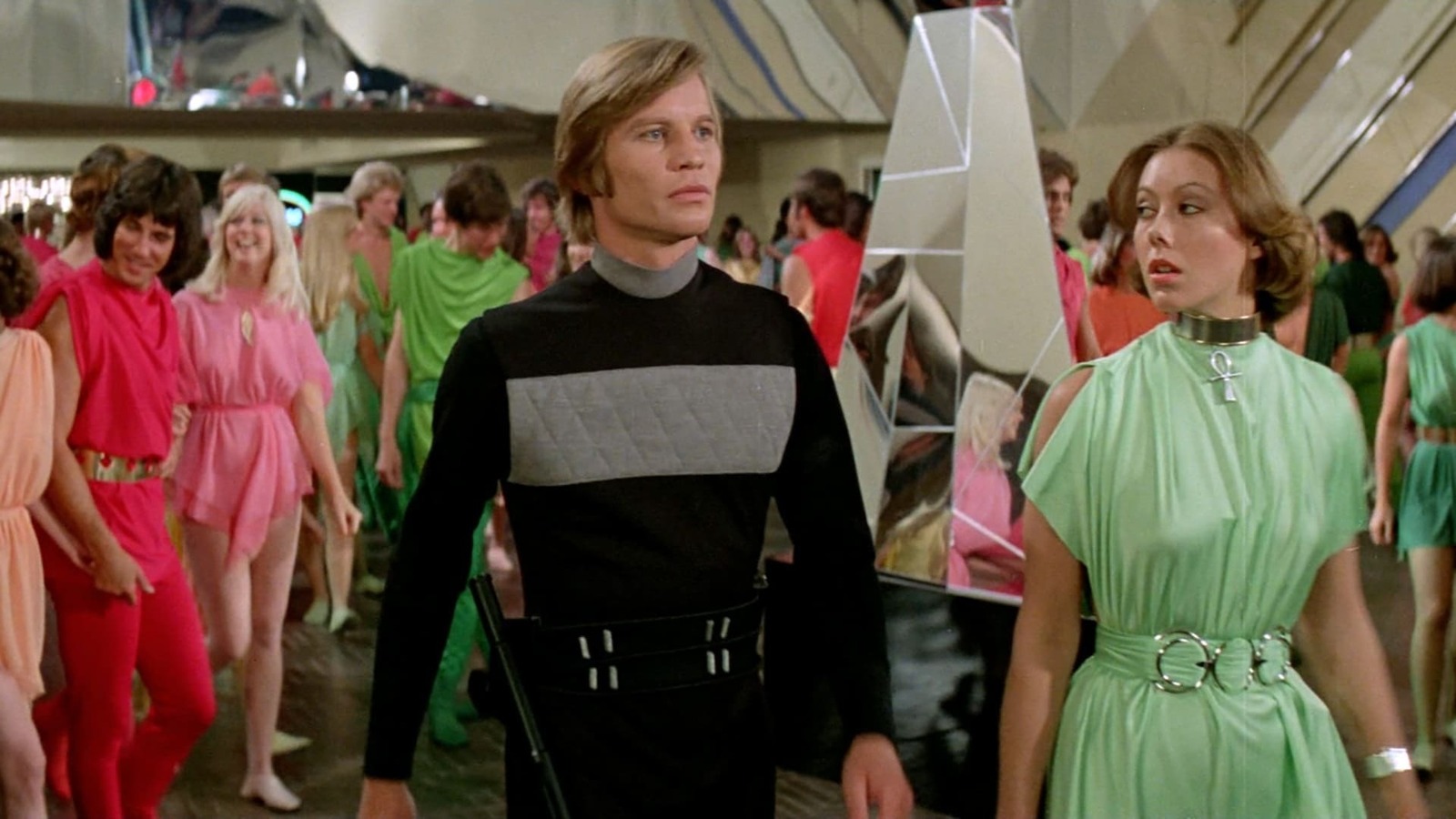
Logan’s Run is one of those—maybe the archetypal—70s science fiction movies that is basically one metaphorical idea running along on a wing and a prayer. It’s about a future utopia where the population is kept to a manageable size by killing people at their 30th birthday. That’s the kind of thing that works pretty well as a reference (“this fuckin’ bar feels like Logan’s Run!!) but doesn’t really make for all that meaty a movie. It interestingly shares with Zardoz a general theme of “ok, so you say we could have a wonderful society through technology, but what kind of sacrifices would we have to make for that, Mr. Technophile???” and then, even more than Zardoz, stumbles on the question of how to make a gripping story out of that. It’s sort of a Kilgore Trout story that managed to escape out into the real world and get made into a movie.

Keith Phipps notes that Loganplays at times like the film is consciously trying to serve as the source for many future parodies of 1970s science fiction,” and that feels about right; chunks of the movie’s weird take on future hedonism even turn up in Demolition Man (and boy is that a movie I didn’t expect to keep turning up in these writeups). Big chunks of it were shot in a mall and look like it; other parts of it are so stagebound that they look like episodes of original-series Star Trek (which, to be clear: no beef for a 1960s TV show to look cheap; major beef for a 1970s feature film to look that cheap).

Continue reading A LIFE IN FILM #3 – LOGAN’S RUN

A LIFE IN FILM #2: BARRY LYNDON

A Life in Film is a project where I’m writing about a movie from every year I’ve been alive.

1975: A SHITHEEL’S PROGRESS

Barry Lyndon (dir. Stanley Kubrick)

For about 25 years, Lyndon’s been the Kubrick movie that I was gonna check out some day. The double-barreled impetus of my needing a 1975 movie that wasn’t Jaws* and the death of Ryan O’Neal meant that now was finally the time. So last night I sat down and fired it up. And: holy shit was that fun!

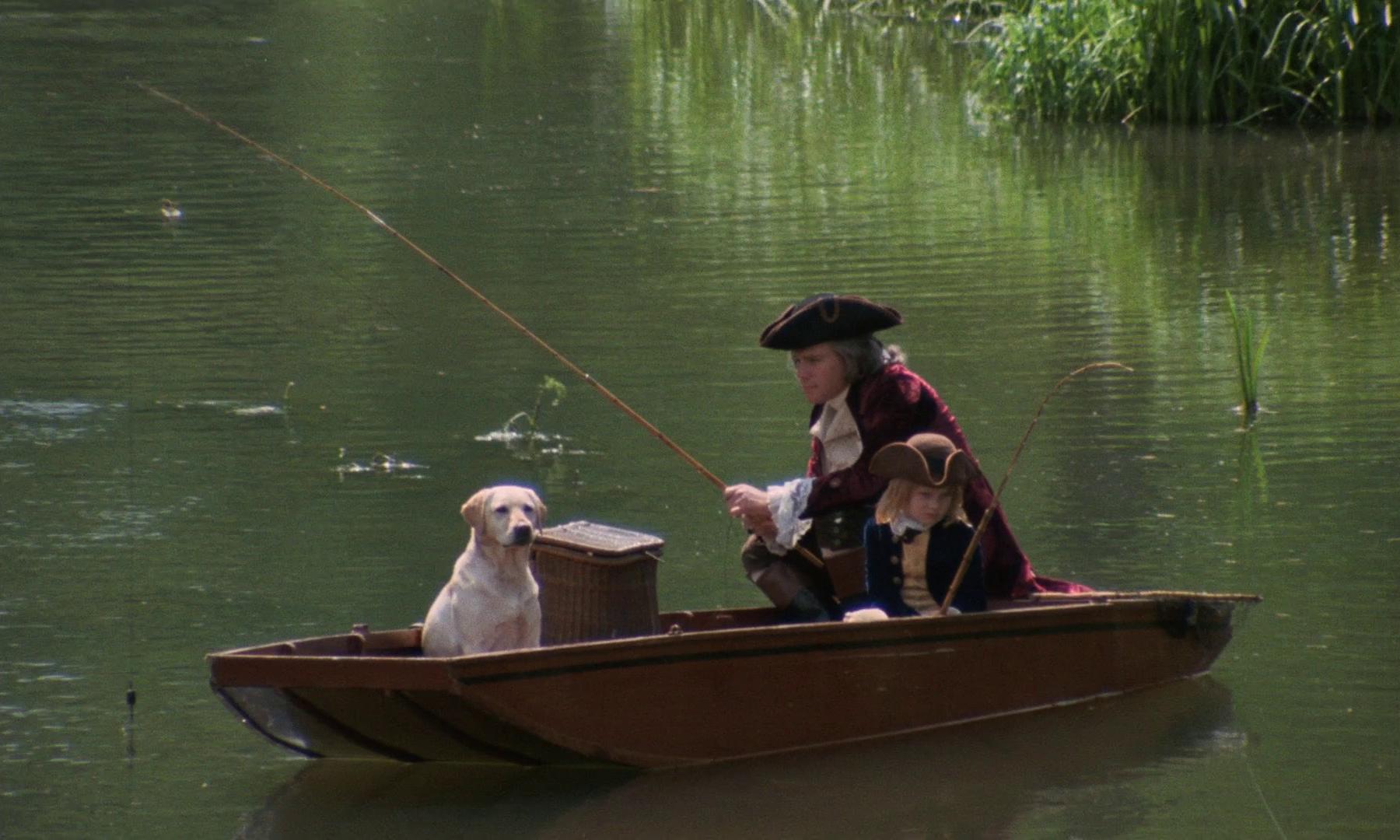
The *real* star of Barry Lyndon, and a couple of people. I’m biased because that dog looks like my dog with a slight color correction, but I think the noble canine stoicism here is one of the funniest things in the movie.

*the original plan was to use Jaws as a vehicle to talk about the business of movies, the modern blockbuster era, and the weird way that these material concerns can get left out of talking about movies, but you know what? There’s plenty of that talk out there.

I knew Lyndon was a long period piece starring Ryan O’Neal as a cad making his way through 18th century Europe; that always sounded dreadfully dull and un-Kubrickian. What I didn’t count on was that the movie would be three hours of sharp, ridiculous humor, or that O’Neal—whose screen presence I normally don’t like at all, always expecting something like this—is perfectly cast here as an empty, unlikable shitheel. I absolutely did not expect a movie whose closest thematic relatives were The Talented Mr. Ripley and Parasite.

Continue reading A LIFE IN FILM #2: BARRY LYNDON

A LIFE IN FILM #1: ZARDOZ

ABOUT THE PROJECT:

I’ve had the itch lately to get back into the writing/blogging game, but couldn’t find an angle. I’ve also been thinking a lot about movies lately as (maybe until pretty recently) the great unifying American artform (not in the sense that all movies are American, but in the sense that for about the last hundred years at least, movies are one of the dominant ways that Americans as a body interact with art). But there’s enough writing and talking about movies already, I thought, listening to a podcast that’s essentially a game show of movie rankings; who needs any more?

But then it hit me that the magical thing about all art is that it sort of has multiple existences—the single, standalone objective work on its own in a vacuum, and then the subjective experience when an individual person actually encounters it. And maybe my subjective encounters with movies are worth writing about.

So: I’m gonna do the full subjective journey, picking a movie that came out in each year of my life and writing about it. I imagine these’ll go all over the place in terms of approach, polish, and length. With this many entries to write (I’ve been alive a lot of years), variety’s the only way to keep it going.

SO LET’S GET ROLLING

1974: THE BIG SWINGS OF ZARDOZ

Zardoz (dir. John Boorman)

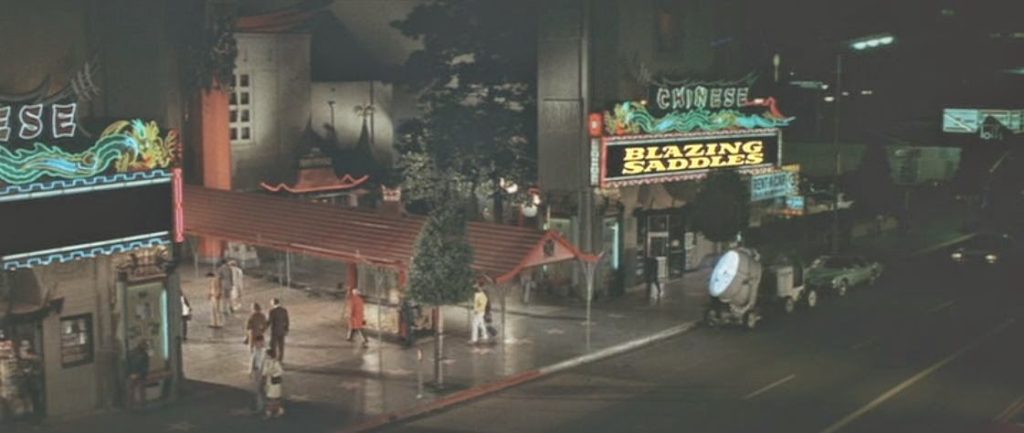
I was originally going to write about Blazing Saddles for 1974, because it was a profoundly formative movie for me, thanks to my parents’ insanely lax standards for what I could watch when I was a kid; but I remembered that I already wrote about it at some length in terms of it being a surprising example of postmodernism.

So instead, let’s talk about Zardoz.

Zardoz has served as a punchline as long as I’ve been aware of it. And I get it, I do. People tend to experience the movie first through pictures of Sean Connery in costume and yeah, it’s a ridiculous costume. The movie’s full of preposterous over-the-top moments, like when the room full of anhedonic future lotus-eaters are shocked by a boner. There’s a giant stone head that floats around the countryside vomiting guns and shouting about the penis.

Continue reading A LIFE IN FILM #1: ZARDOZ

Art Is My Middle Name

pictured: the artist

…is a free newsletter I’m starting as a birthday gift to myself. Each installment will be a short-to-medium thought about art, working with a very broad definition of art: visual arts, comics, movies, music, literature, god knows what else; and covering both appreciating art, art history, art theory, making art, all that. Sometimes focusing on individual works of art or artists; sometimes wandering all over the place. I can’t promise structure or high-quality copy-editing, but I can promise fun (and a bare minimum of one post a month). And although I hope this’ll still be fun and interesting for my pals from the world of academic art history, I want to aim this more at people who like to appreciate art and culture but haven’t spent a bunch of time in seminars talking theory.

SO SIGN UP OVER AT SUBSTACK! I’m in the process of working through my mountain of ideas for posts, and I’ll start sending them out once there’s a moderately-sized pool of subscribers.

QUICK NOTE IN APRIL 2020: I’ve added a separate page for this project, which includes a full index of all of the newsletters so far. Check it out!

SOME TOPIC IDEAS THAT MIGHT MAKE IT INTO THE NEWSLETTER:

  • Kurt Vonnegut’s Bluebeard vs. Mary Gabriel’s Ninth Street Women on telling the story of the Abstract Expressionists
  • Pablo Picasso, Asshole
  • What do people mean when they jabber about Postmodernism?
  • So let’s talk about ugly condo buildings
  • You’re probably qualified to say that you have refined taste
  • Kehinde Wiley makes Jacques-Louis David retroactively worthwhile
  • Disney is choking the life out of our culture
  • So let’s talk about auteurist comics
  • Lynda Barry’s Making Comics is a godsend
  • David Bowie’s big final accidental performance art piece

FRANKLIN, CHARLES SCHULZ’S ACCIDENTAL TOKEN

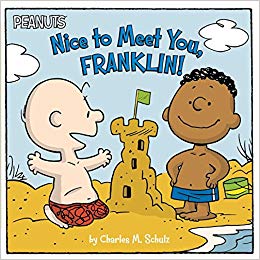
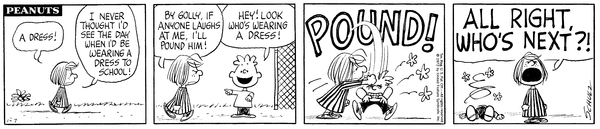
It always hurts to talk about when one of your heroes fails, but that’s what I’m out to do here. Charles Schulz is one of the great figures in comics; Charles Schulz sometimes fell on his ass. He did here. Acting with well-documented good intentions, he tried to do a good thing, and slid into what could most charitably be called mixed success. By introducing Franklin, a black character, into his immensely popular comic strip Peanuts, Charles Schulz wanted to harness his cultural power and use it to send a positive social message about racial harmony. He explicitly wanted to integrate his strip in a way that wasn’t demeaning or insulting. Thirty years later, though, Franklin was considered one of the prime exemplars of tokenism, a perception that has only grown as time has continued to pass.

Peanuts in 1968 was a cultural juggernaut, appearing in well over 2500 newspapers. In an era when newspaper comics carried a cultural weight nearly unimaginable today, Schulz was at the very top of the profession, giving him one of the most visible platforms in the country to trumpet any message he chose.

For the most part, Schulz avoided politics in the strip, instead examining emotional and existential humor.

Jan. 7, 1972
Continue reading FRANKLIN, CHARLES SCHULZ’S ACCIDENTAL TOKEN

Artpal!

You should go check out my new podcast project, Artpal!

And what’s Artpal!, you ask, and why should I check it out? Season 1 of Artpal! is a DIY audioguide to a bunch of works on display at the Minneapolis Institute of Art. I try to provide a different point of view than what the institutional voice of the museum can provide, talking about stuff like Chuck Close’s gross side or why the gender ratio of the museum’s art collection is so skewed. I also try to keep it fun and accessible. The entire first season is available for download, if you want to put it all on your phone and go to the museum in full audioguide fashion. Or the episodes are written so that you could just listen to them anywhere and do image searches if you need to.

The show’s also on itunes and Google Play if you want to skip the website (which does have full show transcripts) and go straight to the podcast experience.

Oh yeah, and remember that I have that other podcast about Uncle Tupelo…

ArtPal! A Demo tape

I’ve been working on a new art-focused podcast project. The whole thing should drop in the end of September or in October of 2018.. Here’s a demo version of the second episode (the first episode is kind of an atypical introduction to the whole thing). If you hear this and have thoughts, I’d love to hear them as I work on producing the actual full first season!

APPROACH THE THRONE: SERENA WILLIAMS, SPORTS ILLUSTRATED, AND THIRD-WAVE FEMINISM

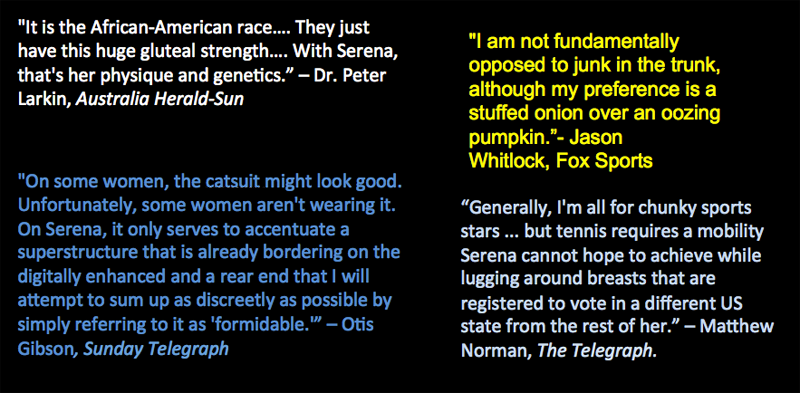
I’d like to start out by laying out a few background statements to take for granted in the interest of time. First, that Serena Williams is a remarkable figure in terms of dominance, significance, and public profile in the sport of tennis. Second, that Williams’ outsized public profile has largely been mediated by photography. And that these photographs have existed within an environment of toxic discourse on Williams’ appearance, in a pattern mirroring that of such other prominent black women as Michelle Obama and Leslie Jones.

The discourse.

Continue reading APPROACH THE THRONE: SERENA WILLIAMS, SPORTS ILLUSTRATED, AND THIRD-WAVE FEMINISM

THOMAS EAKINS, BRUSHING AGAINST THE LIMITS OF SCIENCE

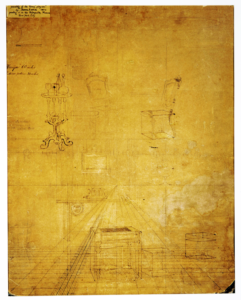
Suppose you’re a painter, and you want capture a realistic scene of two men playing chess in a parlor. How would you do it? Most people, I think, would sit in the room and paint what they saw. Or, depending on their era, maybe they’d work from a photograph. A very meticulous artist might pencil out  couple of single-point perspective lines to guide the recession of the room’s furniture. Vanishingly few artists would use a separate sheet of paper to create a 3-dimensional gridded space where everything in the room was geometrically plotted out with each object considered as its own individual study. But this is exactly what Thomas Eakins did.

Eakins’ perspective workup for The Chess Players

The Chess Players, Thomas Eakins

There’s a decent chance your reaction is: Thomas Who? Eakins is an odd case, a man considered one of the leading American painters of the back half of the 19th century who has slowly slid into something that isn’t quite obscurity but is pretty far from household-name status. You’ve probably heard of the people considered his peers at the time: Winslow Homer, John Singer Sargent, James McNeil Whistler, (kinda) Mary Cassatt. A combination of scandals (Eakins was heavily involved in art education, and was involved in scandals revolving around nude models and students, and it’s a dense thicket that’s almost impossible to judge from 130 years out without getting lost in the gap between then-contemporary and current social mores; last time I looked, his wikipedia page was dominated by speculation about his sexual preference), changing tastes, and the random drift of history have shunted him off to the side. But in his day, Eakins was a big deal, renowned as a new kind of big-brained artist.

Eakins was a creature of his time. He worked during a period of unprecedented exuberance about the progress of science. He brought that spirit into his artistic practice, pursuing representational realism through a combination of techniques derived from science and mathematics. His approach was powerful but flawed, with inconsistencies that led to visual paradoxes; similar paradoxes lurked around the edges of the very science world that inspired him.

Eakins’ belief that perfect representation of reality could be attained in painting through advanced science-based technique was a manifestation of a mode of thought pervasive in late 19th-century American and European intellectual circles, an idea that science and knowledge had reached a summit. His social position in the academic elite of Philadelphia put him in contact with scientists, artists, and thinkers whose output presents a similarly teleological outlook. He basically soaked up their hubris. And this isn’t something I can claim to prove, but I’d guess that the passing of that particular scientific worldview has something to do with the slow drift of Eakins into semi-obscurity.

Continue reading THOMAS EAKINS, BRUSHING AGAINST THE LIMITS OF SCIENCE

SOMEBODY GO BACK AND GET A SHITLOAD OF DIMES

or Postmodernism is Closer Than You Think
So, right now social media is aflame with talk of Jordan Peterson, the latest half-bright pile of mud to figure out that there’s money to be made telling angry young men that they’re right and special. Peterson and the controversy surrounding him are too dull to get into here, but I bring him up because part of his program includes bemoaning postmodernism and accusing it of destroying our morals, corroding society, corrupting the youth of Athens, yada yada yada.

I yada there because this isn’t a new thing. Howling incoherently about postmodernism has turned into a byword of the American right, especially its angrier, weirder wings (for instance, the vague acquaintance from high school, now blocked, who swooped into a facebook thread about the US withdrawal from the paris climate accords and told all of the participants that we were postmodernism-poisoned liberals and cultural Marxists who should kill ourselves). And I say “incoherently” advisedly; I just finished a master’s in art history, wherein I spent a lot of time talking and reading about postmodernism, and I can assure you that very little of it had to do with a vast liberal conspiracy to undermine the work of brave patriots like Alex Jones.

So what’s postmodernism? That’s a complicated thing to lay out, actually, for several reasons. For one thing, postmodernism manifests itself differently in different cultural spheres; architectural postmodernism isn’t exactly the same thing as literary postmodernism, and both are slightly different from postmodernism in visual art, and so on. This is a thing—THE thing—about culture, that answers are usually more complicated and boundaries more fuzzy than we’d like. But that’s the way it is. Anyway, in all of these spheres, postmodernism is (as the name would imply) a cultural reaction to modernism, which in turn was a reaction to (or at least existed in the context of) the romanticism of the late 19th and early 20th centuries. Again, I’m simplifying the hell out of things here, but hopefully in a useful way. Speaking really broadly, modernism was a push towards a theoretical rational order, often marked by form-follows-function minimalism. Think the paintings of Piet Mondrian, or the geometric glass buildings of Ludwig Mies van der Rohe, or the sparse, structured prose of Ernest Hemingway. The uniting theme here is a desire to pare things down to their essence, and (generally) to make the world make sense in terms of rational, quantifiable systems.

Postmodernism (once again, speaking really broadly) rose from the recognition that the world couldn’t really be contained, described, and modeled in the tight, orderly boxes demanded by modernism. And it can’t, for reasons too complicated to get into here, but 20th century developments in math, physics, and culture all ran into some kind of uncertainty or incompleteness on the outer fringes. (Thus, the squishiness of defining postmodernism is both ironic and kind of the point.) Where modernism implies (if often between the lines) a crystalline objective order to everything, postmodernism recognizes the semiotic implication that just about everything in human culture exists in relation to something else (this, I guess, is what drives the political right nuts, if they see it as a push back against tightly-strictured, clear, rational morality handed down by god; I submit that postmodernism isn’t really the problem in that model). Think of it this way: how do you define a word, any word? You do it through other words. Which in turn are defined by other words. It’s a giantic, neverending web of connections that sort of resembles the surface of a waterbed rather than a crystalline bedrock. Which sounds bad and confusing, but the good news is that by this part you’ve read more than 500 words-dependent-on-other-words about the subject and hopefully picked up some kind of informational content; in other words, it turns out that human culture gets along just fine without fixed points.

Anyway: a few hallmarks of postmodernism emerge from what I just said. One is a (usually) playful sense; you can think of postmodernism as a trickster Bugs Bunny character constantly tweaking modernism’s rules-bound Daffy Duck. Another, reflecting the whole interconnected-web-of-referentiality thing, is a propensity towards reference (see the previous sentence for an example; by the way, ever notice that Bugs Bunny is essentially an animated Groucho Marx, even repeating some gags?). Finally, especially in literature, architecture, and film/TV, postmodernism shows an obsession with form and playful tweakings of it.

Which brings me back around to the American right. I’ve noticed a persistent love among people on the right for the movie Blazing Saddles. Jason Lewis, now a tea party republican congressman from Minnesota, often played the theme from Blazing Saddles during his time as a right-wing radio shouter in the Twin Cities. Conservative moaners about political correctness love to hold up Blazing Saddles as a movie that couldn’t be made today because the mean liberal scolds would kill it for being too un-P.C. The overlap between these people and people who decry postmodernism is for all intents and purposes total.

Which is dumb, because Blazing Saddles is a profoundly postmodern movie. It openly takes the constituent chunks of old-fashioned westerns and playfully remixes them, critiquing them in the process. This is the essence of postmodernism. It’s highly referential- some of the jokes don’t make sense unless you know about lawsuits Hedy Lamar filed. It deconstructs itself- look at the last act of the movie, where the action spills off of the set where the movie’s being filmed and takes over an entire movie studio. It’s hard to find a more postmodern moment than Slim Pickens, maybe-and-maybe-not breaking character, yells “Piss on you, I’m working for Mel Brooks!” before beating up Dom DeLuise. Honestly, if someone ever asks you what postmodernism is, you can give them a pretty good answer by just telling them to watch Blazing Saddles and think a little bit about what they’re seeing.
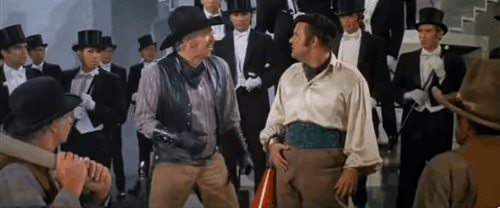
I’m not saying that Mel Brooks and his crew sat down and said “we’re going to make a movie that’s a massive exercise in postmodernism, and also includes fart jokes.” I’m sure they didn’t; that’s just not the way things work. Labels like these are almost always worked out after the fact, except for weird vanguardy cases where someone’s writing a manifesto. It’s more accurate that the cultural moment constantly moves forward and seeps into everything that’s created, and some time after the fact someone looks at it and says “yeah, that’s postmodernism” or “hey look, all of that stuff is similarly ornate, let’s call it baroque” or “boy, sure seems like some kind of rebirth, a renaissance if you will,  happened in Europe there.” Postmodernism started popping up in at least the 40s and eventually came to be the dominant cultural mode of the west in the back half of the 20th century, continuing into today.

Which is to say that people moaning that postmodernism has made immoral soyboys out of all of us don’t know what they’re talking about. They are, ultimately, fish unknowingly complaining about the water they’re swimming in. And if, after complaining, they tune into any cultural product more sophisticated than Little House on the Prairie, they’re being pretty hypocritical.


(Postscript: since I brought it up and then just left it there, and someone’s bound to ask: the “it couldn’t be made today because it’s so un-PC” belief about Blazing Saddles has nothing at all to do with Saddles’ status as a profoundly postmodern movie. It’s a profoundly postmodern movie that happens to be about American race relations; Infinite Jest is a profoundly postmodern novel that has nothing much to say about race relations. Just because a work is one thing doesn’t mean anything about the other thing. Anyway, I don’t know that I buy that statement to begin with. The original possibility Blazing Saddles had a lot to do with Mel Brooks’ clout and production capabilities at that moment; the movie was pushing boundaries then, too, just as it would be now (even if the boundaries in question are different). Anyway, several movies come out every year that are more intentionally offensive than Blazing Saddles (and generally not as good). People who live in a world where multiple Human Centipede sequels have been filmed don’t have very strong legs to stand on when they talk about stuffy atmospheres stopping movies from being made.)

(Post-Postscript: another good moment of unacknowledged 1970s postmodernism was pointed out by pal Max Sparber, who observed how weird/great it is in the theme from Shaft that the backup singers get angry at the lead singer and then reconcile in admiration for the subject of the song, all within the text of the song itself.)

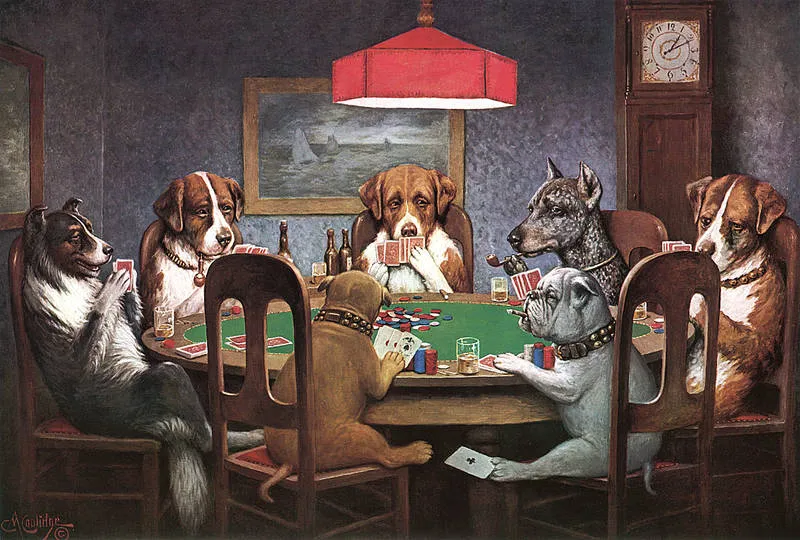
DAVID BOWIE IS__ A BIT OF AN INTERPRETIVE MUDDLE, BUT PRETTY WORTHWHILE IN THE END IF YOU’RE INTO THAT SORT OF THING

quiltedThis was originally written as a paper for an art history class in curation.

Last year, my birthday fell shortly before David Bowie Is, the “first retrospective of the extraordinary career of David Bowie,” closed its run at the Museum of Contemporary Art in Chicago. My wife surprised me with tickets to the long-sold-out show. We packed for a crash road trip, hopped into the car, and drove from Minneapolis to Chicago, listening our way with mounting excitement through the entire Bowie oeuvre during the 10-hour trip.

Viewing the exhibit was an overwhelming rush; the line to enter the museum had stretched around the block. The show was designed to hit attendees through multiple senses – as one walked through the space looking at objects, a location-sensitive headset would blast music or interview clips related to the object under view. The crowd itself – packed into the galleries as tightly as the fire marshals would allow – provided a constant buzz of energy as several rooms full of Bowie superfans communed with artifacts connected with the great man.

We left the exhibit exhausted and happily dazed. But on the drive back to Minneapolis, questions started to bubble up as we talked it over. What had we learned in that exhibit? It didn’t really seem like we’d gotten much in the way of new information. The experience had been intense and fun, but had there been an intellectual point? Had the whole thing really been an enjoyable but ultimately empty wallow in pop idolatry? As months passed and the undigested bolus of David Bowie Is lingered in my head, a slow, slinking surety settled in that it had all been a lot of sound and fury, signifying nothing.

Continue reading DAVID BOWIE IS__ A BIT OF AN INTERPRETIVE MUDDLE, BUT PRETTY WORTHWHILE IN THE END IF YOU’RE INTO THAT SORT OF THING